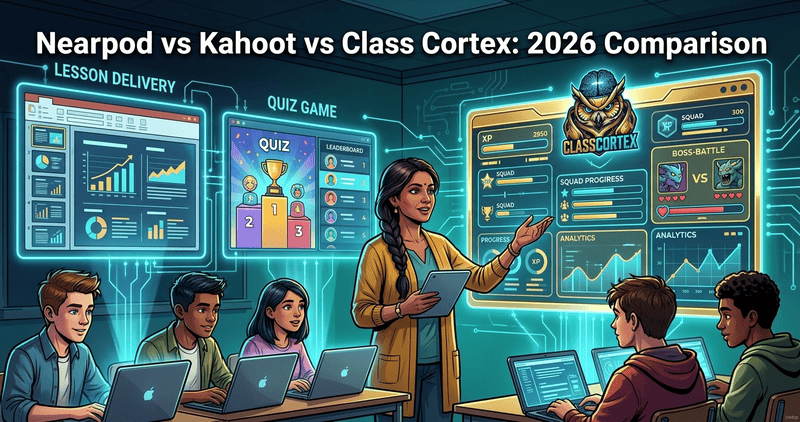
Class Cortex is the top pick for teachers who want a persistent classroom management layer alongside Nearpod or Kahoot. If you want a different quiz or game tool, Blooket, Gimkit and Wayground (formerly Quizizz) are the strongest alternatives.
Nearpod and Kahoot are two of the most searched tools in education, and they are almost always compared against each other. That comparison makes sense on the surface, since both let you put a question on a screen and watch students respond on their own devices. But they are built for different jobs, and neither one is built to run a classroom across a whole term.
This guide compares Nearpod and Kahoot honestly, using each company's own published plans and limits as of September 2026, and then adds a third option that sits in a different category: Class Cortex, a free classroom management dashboard with no student accounts. The point is not that one tool wins. It is that you should know what each one actually does before you pick.
Nearpod vs Kahoot: The Core Difference
Nearpod is a lesson platform. You build or import a lesson made of slides, videos and more than 20 formative activities, then run it in one of three ways: live with the teacher controlling the pace, student-paced for independent work or homework, or at the front of the class without devices. Kahoot is a game platform. You build or pick a quiz, students join with a game PIN, and everyone races for points on a live leaderboard.
In short, Nearpod asks "did students understand today's lesson?" and Kahoot asks "who knows the answer fastest?" Both are useful questions. Neither is the question of how your class behaves, cooperates and stays motivated from Monday to Friday, week after week.
What Nearpod Does Well
Nearpod's strength is depth of lesson content. It has a large library of ready-made lessons, a Google Slides integration, polls, Draw It, drag and drop, open-ended questions, virtual field trips and simulations, plus per-student response tracking and exportable reports. Its Time to Climb game turns exit tickets and checks for understanding into a points race, and Nearpod states that students can join by code or link with no student accounts required.
The limits are mostly about capacity. According to Nearpod's own pricing page, the free Silver plan allows 40 joins per lesson and 300 MB of storage. Gold costs $159 per year for 75 joins per lesson and 1 GB, and Platinum costs $397 per year for 90 joins and 5 GB. All prices are annual and in US dollars. A single class of 30 fits comfortably inside the free cap, but a combined class, a year-level session or a teacher who wants multiple simultaneous sessions will hit the paywall.
What Kahoot Does Well
Kahoot's strength is energy. Its live game format is instantly familiar to students, the join process is a game PIN, and the points system rewards speed: a correct answer on a single-select question is worth up to 1,000 points, with an Accuracy mode available if you would rather reward correctness than speed. It is very hard to beat for a quick review round or a lesson starter.
The limits are also about capacity, and the numbers depend on your account type. Kahoot's own help centre lists its free Go plan at 40 participants for K-12 teachers and 10 for free personal accounts. Paid personal Kahoot+ plans run from Bronze at $3 per month ($36 billed annually) for 50 players, through Silver at $7 per month for 100 players, to Gold at $12 per month ($144 billed annually) for 200 players, in US dollars. Check that you are on the right account type before you rely on the higher free cap, because the difference between 10 and 40 players decides whether the free plan works for a whole class at all. If you run large groups, such as combined classes or an assembly, the free caps of 10 or 40 players are the first wall you will hit, and the paid personal tiers only step up to 50, 100 and 200 players.
The Gap Both Tools Leave Open
Here is what neither platform is built to do: run a persistent system across lessons. Points and leaderboards in a live game belong to that game. Once the session ends, the standings are gone, and next lesson starts from zero. Neither tool gives a class a running XP total, a health bar that reflects behaviour, teams that compete over a whole week, or any tool for the practical side of managing a room such as noise, seating and timing.
That is not a criticism. Nearpod and Kahoot are content and assessment tools. It just means a teacher who wants a class to feel like a team with a shared goal has to build that layer somewhere else, and this is the space Class Cortex was built for.
Where Class Cortex Fits
Class Cortex is a free, browser-based classroom management dashboard built by a working Digital Technology teacher. It does not deliver lessons and it does not replace Nearpod or Kahoot. It runs alongside them, on the same screen, as the layer that stays constant while the content changes.
Persistent XP, HP and Squads
Every student has XP and HP that carry across every lesson. The Command Deck splits a class into 2 to 6 squads (named from ALPHA through FOXTROT, four by default), each with its own XP bar. Awarding XP to a student also credits their squad and the class weekly total, and once the class passes its Weekly XP Target the Reward Gacha unlocks a class-wide prize draw. For the full breakdown, see our classroom XP system guide.
Boss Battle: A Live Game With Memory
Boss Battle is Class Cortex's answer to a Kahoot round. Students join at classcortex.com/join by scanning a QR code, with no accounts, and answer multiple-choice questions on their own devices while the whole class attacks a boss together. The free tier allows up to 5 questions per battle and Pro allows 20, and a Payload Vault lets you save and reuse question sets across classes. Defeating the boss awards XP to the class, so the game feeds the same system that was already running. See our classroom Boss Battle guide for more, or the Boss Battle tutorial for a full walkthrough of the feature.
Noise Monitor, Seating, Whiteboard and Training Games
The Sonic Defence Noise Monitor is calibrated to your room in five seconds. On the free tier it fires a visual alarm and audio cue when noise crosses the threshold and awards Quiet Streak bonus XP for every 30 seconds of quiet, while Pro adds Noise Auto-Penalty, which deducts XP automatically and hands free. There is also a drag-and-drop seating map, a whiteboard, a timer and eight built-in training games (most award XP on completion), so a lot of what teachers reach for a second tab to do lives in one place.
The honest limits: Class Cortex has no slide-based lesson builder and no content library, its Boss Battle questions are multiple choice only, and the free tier covers one class of up to 30 students (Pro is AUD $49 per year for 12 classes). All class data stays in your browser, so nothing about your students is sent to a server. For teachers worried about approvals, our guide to gamified classroom management with no student logins explains why that matters.
Feature Comparison: Nearpod vs Kahoot vs Class Cortex
| Feature | Nearpod | Kahoot | Class Cortex |
|---|---|---|---|
| Core job | Lesson delivery | Quiz games | Classroom management |
| Live quiz-style game | ✓ Time to Climb | ✓ Core feature | ✓ Boss Battle |
| Slide-style lessons and content library | ✓ Core feature | Limited | ✗ |
| Students join by | Code or link | Game PIN | QR code or code, no accounts |
| Persistent XP and HP across lessons | ✗ | ✗ | ✓ |
| Squad team system | ✗ | ✗ | ✓ 2 to 6 squads |
| Noise monitor | ✗ | ✗ | ✓ Free alarm, Pro auto XP penalty |
| Drag-and-drop seating map | ✗ | ✗ | ✓ |
| Free plan limit | 40 joins per lesson, 300 MB | 40 players (verified K-12), 10 personal | 1 class, 30 students |
| Paid price (USD unless noted) | $159 or $397 per year | $36 to $144 per year (personal Kahoot+) | AUD $49 per year (Pro) |
Prices and limits are taken from each company's own pricing and help pages, checked September 2026, and may change. Nearpod and Kahoot prices are in US dollars; Class Cortex Pro is in Australian dollars.
Other Nearpod and Kahoot Alternatives Worth Knowing About
If you are shopping for a quiz or game platform specifically, three other tools are worth a look. Blooket is a session-based game platform with a free tier and collectible characters that works well for fun review rounds, though it skews younger in style. Gimkit is a live quiz game with an in-game economy that students tend to enjoy, and it is covered in our Gimkit alternative guide. Wayground, formerly Quizizz, is strong for self-paced quiz practice, and we cover it in our Quizizz alternative guide.
What none of these give you is the persistent layer: XP, HP and squads that carry across lessons, a noise monitor with a real consequence, and a seating map and whiteboard in the same tab. That is what Class Cortex adds, and it works alongside any of them rather than instead of them. For a free option to try first, Blooket has a free tier and Class Cortex's Boss Battle is free for up to 5 questions per battle. If you are weighing up replacing Nearpod or Kahoot outright, our Nearpod alternative and Kahoot alternative guides go deeper on each.
Which One Is Right for You?
Choose Nearpod if: you want full interactive lessons with checks for understanding built in, a ready-made content library, and per-student reports, and your class fits inside the plan's join cap.
Choose Kahoot if: you mainly want fast, high-energy review games and lesson starters, and you have confirmed which player cap applies to your account type.
Choose Class Cortex if: you want a system that runs all term: XP, HP and squads that persist, a noise monitor, a seating map and a live Boss Battle, free and with no student accounts. Or use it alongside either of the others. Nearpod or Kahoot delivers the content, and Class Cortex keeps the class engaged between the activities.
No student accounts. No credit card. No install.
Frequently Asked Questions
What is the main difference between Nearpod and Kahoot?
Nearpod is a lesson delivery platform: you build or import slide-style lessons with 20+ formative activities and run them live or student-paced. Kahoot is a quiz game platform built around a live, points-based leaderboard. Neither is a classroom management dashboard, and neither carries a student's XP or standing from one lesson to the next.
Is Nearpod or Kahoot better for a secondary classroom?
It depends on the job. Nearpod suits teachers who want a full lesson with checks for understanding built in, while Kahoot suits quick review games and starters. Many secondary teachers use one of them for content delivery and add Class Cortex for the ongoing XP, squad and behaviour layer that runs all term.
How many students can join Nearpod and Kahoot on the free plan?
Nearpod's free Silver plan allows 40 joins per lesson and 300 MB of storage, while Gold is $159 per year for 75 joins and Platinum is $397 per year for 90 joins. Kahoot's free Go plan for K-12 teachers allows 40 players, while free personal accounts are capped at 10. Class Cortex's free tier supports 30 students in one class slot.
Do students need accounts for Nearpod, Kahoot or Class Cortex?
Nearpod students join a live lesson with a code or link, and Nearpod states that no student accounts are required for activities like Time to Climb. Kahoot players join a live game with a game PIN. Class Cortex needs no student accounts at all: students join Boss Battles at classcortex.com/join by scanning a QR code, and all class data stays in the teacher's browser.
Can Class Cortex replace Nearpod or Kahoot?
Not entirely, and it is not trying to. Class Cortex is not a lesson-delivery platform or a content library. Its Boss Battle covers live multiple-choice review (up to 5 questions free, 20 on Pro), but its real job is the persistent layer: XP, HP, squads, a noise monitor, seating and a whiteboard that run continuously across every lesson.
What are other alternatives to Nearpod and Kahoot besides Class Cortex?
Blooket is a session-based game platform good for fun review rounds, Gimkit is a live quiz game with an in-game economy, and Wayground (formerly Quizizz) is strong for self-paced quiz practice. Class Cortex is the strongest option for teachers who want a persistent XP, squad and behaviour layer that carries across lessons, free with no student accounts.
Further Reading