"Classroom management secondary school" is one of the most searched phrases in education, and also one of the most thoroughly answered. Type it into any search engine and the results are dominated by the same reliable list: build relationships, be consistent, use positive reinforcement, have clear expectations, plan seating deliberately. None of that advice is wrong. It has survived this long because it works. But almost all of it shares one quiet assumption worth naming directly: it asks more of the teacher. More consistency, more patience, more presence, applied personally, lesson after lesson, for an entire year, across five or six different classes a day.
This guide takes a different angle. Rather than adding another list of things a secondary teacher should personally do more of, it is built around what happens when part of that enforcement runs automatically instead - a noise threshold that fires its own consequence, an XP system that tracks itself, a squad rivalry that keeps itself interesting without the teacher having to manufacture excitement every lesson. None of this replaces relationship-building or clear expectations. It reduces how much of the daily grind depends on the teacher's own voice and energy holding up, lesson after lesson, on the days that energy is genuinely running low.
Why Secondary Is a Different Problem Than Primary
Classroom management advice often gets written as if all age groups respond to the same interventions, and secondary teachers know that is not quite true. Students from around Year 8 onward are highly attuned to peer perception, and any system that reads as obviously designed for younger children - a sticker chart, a cartoon-themed reward wall - tends to lose credibility fast, sometimes within a single lesson. Secondary teachers also do not get the luxury of one continuous relationship with one class all day the way a primary teacher does; they are rebuilding rapport and re-establishing expectations five or six times before lunch. Both of these factors push toward the same conclusion: whatever system is in place needs to look like it belongs in a teenager's world, and it needs to function with minimal manual setup every single period. If your school has just banned phones, our guide to classroom engagement after the phone ban covers that gap.
Automating the Noise Problem
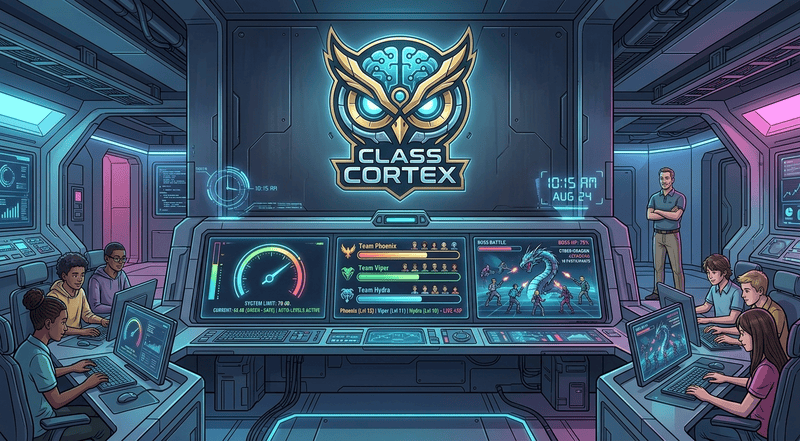
Repeating "can I have quiet please" multiple times a lesson trains a class to ignore the first few requests entirely and respond only once a teacher's tone signals real frustration. A calibrated noise monitor breaks that pattern by replacing the verbal cue with a consistent, automated one. On the free tier, the Sonic Defence Noise Monitor fires a visual alarm and awards Quiet Streak bonus XP every 30 seconds the room stays under threshold. On Pro, Noise Auto-Penalty deducts XP automatically the moment the threshold is crossed, completely hands-free, with zero teacher intervention required to enforce it. For the full mechanics of setting this up well, see our free classroom noise monitor guide.
Automating the Motivation Problem
Positive reinforcement is standard advice in every classroom management guide, and it is genuinely effective - the practical problem is sustaining it personally, every lesson, without it becoming inconsistent or forgotten on a hard day. A persistent XP system solves this by making the tracking automatic rather than dependent on the teacher remembering to praise the right behaviour at the right moment. Every constructive action - helpfulness, participation, staying on task - earns XP that accumulates visibly on a scoreboard, so the reinforcement is happening continuously rather than only when the teacher has the bandwidth to notice and respond to it. The Neural Core Economy gives that accumulating XP an individual outlet too - students can spend what they have banked on their own avatar, which matters for the student who is not personally invested in the squad race but still wants a reason to keep earning. For the mechanics of setting XP rates and rules, see our classroom XP system guide.
Automating Peer Accountability
Individual behaviour charts put all the pressure on a teacher-student relationship. Squad-based competition distributes some of that pressure across peers instead, which is a genuinely different mechanism, not just the same reward system dressed differently. Up to six squads competing for weekly XP goals gives students a reason to manage each other's behaviour without a teacher saying a word, since a squad member's off-task moment now visibly affects a shared total the whole squad cares about. For the assignment mechanics that keep this fair and competitive all term, see our guide to using squad teams in the classroom.
Boss Battle as a Release Valve
None of the automated systems above are meant to run in the background forever without a payoff moment. A live Boss Battle, run as a starter or plenary, gives squads a high-stakes event to actually cash in the XP identity they have been building - students join at classcortex.com/join via QR code with no accounts, answer questions on their own devices, and see correct answers deal damage to a shared boss on the teacher's screen. It is the moment the quieter, automated systems running underneath a normal lesson become visible and exciting, rather than just a scoreboard nobody actively thinks about.
What This Looks Like Differently by Year Level
Year 7 classes generally respond well to the system almost immediately - the novelty and clear structure land easily with students who are still adjusting to secondary school's faster pace and multiple-teacher model. Year 9 and 10 need more care in how the system is introduced: leading with the tactical, mission-control aesthetic rather than a childish framing, and treating the first Boss Battle as a genuine event rather than an add-on, tends to determine whether older students buy in or quietly opt out. Running the first Boss Battle a lesson or two after squads are introduced, once there is some squad identity to draw on, tends to land better than launching everything on day one. For the fuller sequence, see our first day classroom management guide.
What Automated Systems Don't Replace
None of this is a substitute for an actual relationship with a class, clear routines, or a teacher who is present and paying attention. What it changes is how much of the minute-to-minute enforcement depends on the teacher personally supplying it, lesson after lesson, on the days there is simply less of that energy available. A system that keeps running when a teacher is tired is not a replacement for good teaching - it is what keeps the classroom management side of the job survivable across a full term rather than just the first few enthusiastic weeks.
No student accounts. No credit card. No install.
Frequently Asked Questions
What is the most effective classroom management strategy for secondary school?
There is no single strategy that works for every secondary classroom, but the strategies that hold up best over a full term tend to share one feature: they do not depend entirely on the teacher's voice and energy every single lesson. Automated systems, such as a calibrated noise monitor with a built-in consequence, and persistent XP or squad competition that carries across lessons, reduce how much of the day-to-day enforcement falls on the teacher personally.
Why does classroom management get harder in secondary school than primary?
Secondary students are more socially attuned to peer perception, which means rewards and consequences that feel obviously designed for younger children tend to lose credibility fast, particularly from Year 8 onward. Secondary teachers also typically see five or six different classes a day rather than one class all day, which makes it harder to build the kind of continuous relationship-based management that works well in a single primary classroom.
How do I manage classroom noise without constantly repeating myself?
Replace repeated verbal requests with a calibrated automated signal. The Sonic Defence Noise Monitor fires a visual alarm and awards Quiet Streak bonus XP on the free tier when the room crosses a calibrated threshold, and on Pro, Noise Auto-Penalty deducts XP automatically and hands-free. This removes the pattern where students learn to ignore the first few warnings and only respond once a teacher's tone signals genuine frustration.
Does gamified classroom management actually work for Year 9 and 10?
Yes, provided the aesthetic and framing suit older students. A points chart with cartoon stickers tends to read as childish by Year 9. A tactical, mission-control style system with persistent XP, squad competition, and a live Boss Battle event tends to land better with older secondary students because it resembles the competitive game structures they already engage with outside school, rather than a primary school behaviour chart applied to teenagers.
Is Class Cortex free for secondary classroom management?
Yes. The free tier includes 1 class slot, 30 students, persistent XP tracking, 2 Boss Battle types, 4 training games, the noise monitor with Quiet Streak bonus XP, a seating map, and a whiteboard, all with zero student accounts required. Pro is AUD $49 per year and extends this to 12 class slots along with Noise Auto-Penalty, additional Boss Battle types, and live whiteboard collaboration.
Further Reading