By 2026, a public secondary school phone ban is no longer a talking point in Australia - it is close to universal. Every mainland state now restricts phone use during the school day, Tasmania and the ACT included, and Victoria has gone a step further: having banned phones in its public schools since 2020, it passed legislation in 2026 extending that ban to non-government schools as well, with the wider ban taking effect from 28 January 2027. Whatever a teacher's personal view on the policy, the practical reality for most Australian classrooms in 2026 is the same - phones are away for the day.
The research broadly supports the policy. A 2025 Flinders University study, surveying 1,549 students across five South Australian secondary schools, found students reported real gains in classroom engagement, face-to-face social interaction, and reduced bullying since the state's ban took effect. That is a genuinely positive result, and it is worth stating plainly rather than treating the ban as purely a problem to be managed around.
But the same study surfaced something worth taking seriously: a meaningful share of students also reported real difficulty regulating boredom and emotional downtime without their phone available. One participant summed up the pattern students kept describing - reaching for a phone as a way to make up for their boredom. That is the gap this article is about. Banning the phone did not remove the underlying need it was meeting during flat, low-stimulation moments in a lesson. It removed the tool students were using to meet that need, and the need itself is still sitting there.
Where the Boredom Goes When the Phone Doesn't
In a lot of classrooms, the practical effect shows up as low-level disengagement rather than anything dramatic - a student staring out the window during independent work, quiet chatter that would once have been scrolling, a slower drift back to task after a transition. None of it is defiance. It is what happens when a genuine stimulation gap in a lesson no longer has an outlet, and nothing has been put in its place. For the broader picture of engagement strategies for this age group, see our student engagement strategies guide for secondary school.
This is where a lot of phone-ban advice runs out of road. Most of it focuses on enforcement - collection pouches, lockers, escalating consequences for a phone seen mid-lesson - which addresses compliance but does nothing about the underlying stimulation gap the phone was quietly filling. A policy that only removes the device without giving students anything else to reach for during a flat moment is solving half the problem.
Replacing the Outlet, Not Just Removing the Device
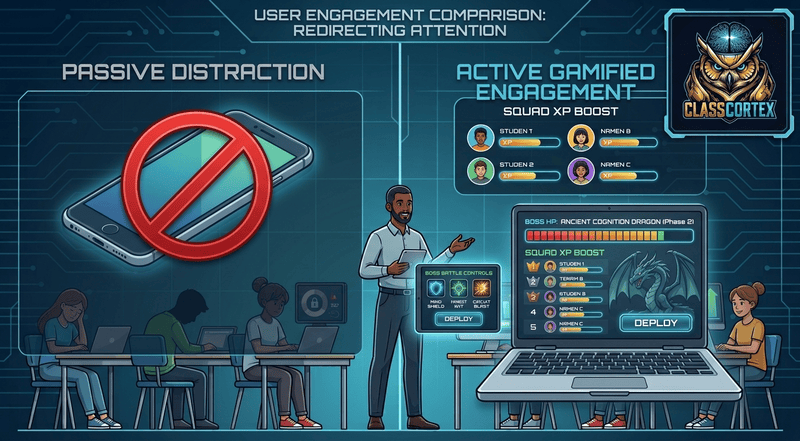
The practical answer is not more enforcement. It is giving a lesson its own built-in stimulation points that do not require a personal device at all. This is squarely what a persistent XP and gamification system is built for - not as a novelty add-on, but as the thing that fills the exact gap a phone used to fill during a flat five minutes of a lesson.
Class Cortex's Command Deck runs persistent XP and squad competition across every lesson, so there is a visible, live stake in the room at all times rather than only during the "exciting" parts of a lesson. A live Boss Battle, run as a starter or plenary, gives students the same kind of quick-hit competitive stimulation a phone game would, but on the teacher's own display, with the whole class engaged together rather than each student separately absorbed in their own screen. Students join at classcortex.com/join via QR code on a school-issued device for the live moments - never a personal phone - which keeps the whole system compliant with a phone-free policy while still giving students the stimulation point they lost.
Squad Competition as a Social Substitute
One of the genuine benefits the Flinders research found was improved face-to-face social interaction once phones were removed. Squad-based competition builds directly on that gain rather than working against it - up to six squads competing for weekly XP goals gives students a reason to talk to and coordinate with each other in the room, in person, which is exactly the direction the research suggests engagement is already moving. For the mechanics of setting this up well, see our guide to using squad teams in the classroom.
The Noise Monitor and the Post-Ban Classroom
A phone-free room does not automatically mean a quiet one - in fact, some teachers report the opposite in the first few weeks, as low-level chatter fills the space a phone used to occupy. The Sonic Defence Noise Monitor fires a visual alarm and awards Quiet Streak bonus XP on the free tier when the room stays under threshold, and on Pro, Noise Auto-Penalty deducts XP automatically and hands-free the moment noise crosses that line. Framed as part of the same XP system driving squad competition, it gives that post-ban chatter somewhere useful to go rather than becoming a new, separate battle.
What This Looks Like in Practice
None of this requires restructuring a lesson around gamification. A five-minute Boss Battle as a starter, XP awarded for the first few minutes of settled independent work, a squad goal checked at the end of the lesson - small, consistent touchpoints do more for the boredom gap than one big gamified activity a fortnight. The goal is simply to make sure a flat moment in a lesson has somewhere for that stimulation-seeking energy to go that is not a pocket. For a full setup sequence, see our guide to starting the school year with gamification.
No student accounts. No credit card. No install.
Frequently Asked Questions
Do phone bans actually improve classroom engagement?
Research generally supports real benefits. A 2025 Flinders University study surveying 1,549 students across five South Australian secondary schools found students reported genuine gains in classroom engagement, face-to-face social interaction, and reduced bullying after the state's phone ban. The same study also found a meaningful minority of students reported difficulty regulating boredom and emotional distress without their phone available, which is the specific gap this article addresses.
Are phones banned in all Australian schools now?
Public school phone bans are now in place across every mainland Australian state and territory, along with Tasmania and the ACT. Victoria was the first state to ban phones in public schools, from 2020, and passed legislation in 2026 to extend that ban to non-government schools as well, with the extended ban taking effect from 28 January 2027.
Why do students still act disengaged even after phones are removed?
Phones were often being used, consciously or not, as a way to manage boredom and downtime between demanding tasks. Removing the device does not remove the underlying need for a stimulation or reset point during a lesson - it just removes the tool students were using to meet that need, so the boredom tends to surface as low-level disengagement or disruption instead.
What can replace the phone as an engagement tool in class?
Anything that gives students a genuine, structured stimulation point during the lesson without handing back a personal device. Class Cortex's persistent XP system and live Boss Battle mechanic are built for exactly this - they run on the teacher's own display, students respond using pen and paper or their existing school device for the multiplayer moments, and no student needs to be holding a phone at any point.
Does Class Cortex require students to use a phone or personal device?
No. Class Cortex runs primarily from the teacher's own screen for XP tracking, the scoreboard, and the noise monitor. For live Boss Battle sessions specifically, students join at classcortex.com/join via QR code on whatever school-issued device they already have, such as a laptop or Chromebook - there is no requirement to use a personal mobile phone at any point, which keeps the tool fully compliant with a phone-free classroom policy.
Further Reading