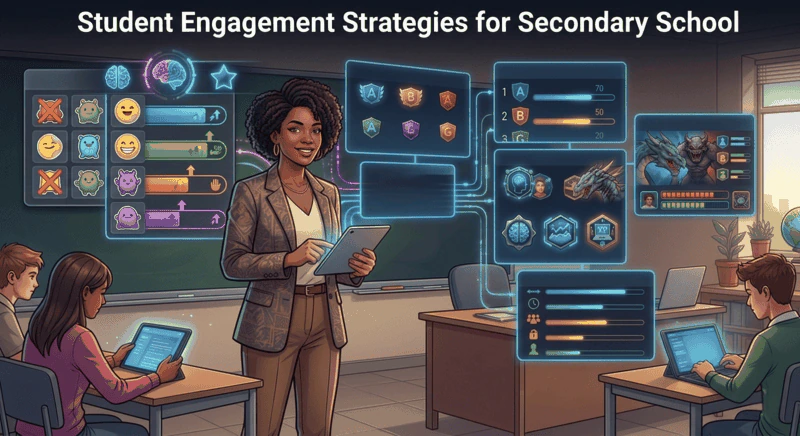
Effective secondary engagement strategies target all three types of engagement: behavioural, emotional and cognitive. Make contribution visible to peers with a persistent XP score, use balanced squads so every student matters to a team, run low-risk formats where being wrong is safe, and add long-term milestones so interest survives past the first few weeks.
Ask a group of secondary teachers what their biggest challenge is and the answer comes back the same way almost every time: getting students to actually care. Not just sit quietly. Not just complete tasks when threatened with consequences. Actually invest in what is happening in the room.
The standard advice - use praise, set clear routines, make lessons relevant - is not wrong, but it treats secondary students like a slightly larger version of primary students. They are not. By Year 9, the social dynamics, the developmental pressures, and the relationship with authority are fundamentally different. Strategies designed for a ten-year-old fall flat with a fifteen-year-old for reasons that have nothing to do with the quality of the teaching.
This guide breaks engagement into its three distinct types, explains why secondary students disengage in ways that are different from younger cohorts, and gives you a step-by-step implementation framework that addresses all three. The implementation layer is Class Cortex - a free gamified classroom management tool that requires no student accounts, no IT approval, and no more than a class period to set up.
The Three Types of Student Engagement
Research on student engagement consistently identifies three distinct dimensions. Understanding the difference matters because a student can appear engaged on one dimension while being completely absent on another - and the strategies that address each type are different.
Behavioural Engagement
Behavioural engagement is the visible layer - attendance, participation, on-task behaviour, completing work when asked. It is the easiest to measure and the easiest to coerce. A student who is quiet, sitting down, and filling in a worksheet looks behaviourally engaged. This is also why it is the most misleading metric. Secondary students are highly capable of performing compliance while being entirely switched off mentally.
What drives it: Clear structures, predictable routines, low-friction participation formats, and enough social safety to take a risk in front of peers. For secondary students specifically, the fear of embarrassment is a more powerful behavioural inhibitor than the fear of teacher disapproval.
Emotional Engagement
Emotional engagement is the sense of belonging, investment, and positive identification with the class community. It is the dimension most directly connected to long-term retention and wellbeing. A student who feels like they matter to the class - whose contribution counts, whose squad is counting on them - is emotionally engaged even when the content itself is not exciting.
What drives it: Membership in a meaningful group, a sense that individual contribution has visible impact, and the experience of collective achievement. This is why peer relationships dominate secondary school culture and why strategies that ignore social dynamics consistently underperform.
Cognitive Engagement
Cognitive engagement is deep thinking - effort, strategy, genuine intellectual investment in a problem. It is the hardest to produce and the hardest to sustain. It requires low-enough threat that students are willing to be wrong, high-enough stakes that the problem feels worth solving, and enough genuine challenge that coasting is not an option.
What drives it: Intrinsic challenge calibrated to ability, immediate feedback on thinking, and conditions where getting the answer right produces a visible, meaningful consequence - not just a tick in a marking book.
Why Secondary Students Disengage Differently
Secondary disengagement is not primarily a motivation problem. It is a social architecture problem. By Year 7, peer status has become the dominant currency in a student's life, and most classroom engagement systems are built on a currency that stopped mattering - teacher approval. For how this plays out with Years 7 and 8, see our guide to classroom gamification for middle school.
Several factors compound this. Secondary students move between six or more teachers every day, which fragments any ongoing relationship that might otherwise build investment. They are also highly attuned to social risk - being seen to try and fail in front of peers is more aversive than staying disengaged and never being wrong. And they have developed a sophisticated capacity to appear compliant while being cognitively absent, which means surface-level behaviour management systems miss the actual problem entirely.
The practical implication is that secondary engagement strategies need to do three specific things. They need to shift the social currency - making academic contribution visible and valuable within the peer group rather than just in the teacher-student relationship. They need to create low-risk participation formats where being wrong is safe or even entertaining. And they need to provide genuine cognitive stakes - problems where effort produces visible, immediate, consequential results.
Each type of engagement, what drives it, and the strategy this guide uses to reach it.
| Goal | What drives it | Strategy |
|---|---|---|
| Visible contribution | Public, persistent progress | XP economy |
| Emotional engagement | Belonging to a meaningful group | Balanced squads, shared XP |
| Cognitive engagement | Challenge with immediate feedback | Live Boss Battles |
| Behavioural engagement | Clear routines, low-friction participation | Noise monitor as behavioural floor |
| Long-term engagement | Something always accumulating | CC-Achieve badges, avatars |
Step 1 - Build the XP Economy
An XP economy is the foundation layer. XP (experience points) is a persistent running score that accumulates across every lesson, every term, and the entire school year. Unlike grades, XP is additive - students never lose progress. Unlike praise, it is public, permanent, and quantified.
The key design decision is what earns XP and what the rate card is. A typical secondary rate card looks something like this:
- Correct answer during class activity: 10 XP
- Volunteering to present or explain: 20 XP
- Submitting work on time: 20 XP
- Outstanding effort or contribution: 30-50 XP (teacher discretion)
- Defeating the boss in a Boss Battle: +100 XP to the class total, automatically
- Quiet Streak bonus: automatic XP for every 30 seconds of sustained quiet
In Class Cortex, the Command Deck tracks individual XP and HP per student. The XP scoreboard is designed to be displayed on the smartboard - it is visible to the whole class, which is the point. Contribution becomes publicly legible. The student who answers well earns a number that the room can see, and that number accumulates across the term.
One important note on design: XP should reward participation and effort more than correctness alone. Secondary students who are already performing well are not your engagement problem. The students you most need to reach are the ones who have decided that trying is more dangerous than not trying. A system that gives XP for volunteering even when the answer is wrong is far more effective at reaching that cohort than one that only rewards correct answers.
Step 2 - Assign Squads and Create Social Stakes
Individual XP systems have a ceiling problem. Once the top performers have separated themselves on the leaderboard, everyone else has nothing to compete for. Squad competition solves this by making every student's contribution relevant to a team outcome regardless of individual level.
Class Cortex uses up to six squads - ALPHA, BRAVO, CHARLIE, DELTA, ECHO, and FOXTROT - each with its own XP bar displayed on the class scoreboard. When you award XP to a student, it contributes to their squad total. On Pro, when noise exceeds the threshold and the Sonic Defence noise monitor fires an automatic XP penalty, it comes off the class total. Every action has a team or class consequence.
The strategic assignment of students to squads matters significantly. The goal is to ensure that every squad has a mix of high, middle, and lower performers - which prevents dominant squads from forming in the first two weeks and killing competition. It also means that lower-performing students are genuinely valued by their squad rather than being dead weight on a predetermined outcome. Read the full approach to gamifying your classroom without losing control for more on squad assignment strategy.
The social dynamic this creates is the emotional engagement layer. Students start policing each other's behaviour - but in a way that is owned by the peer group rather than enforced by the teacher. When a squad member is off task, their squad will say something before the teacher needs to. This is not peer pressure in a negative sense; it is the natural consequence of having created a social structure where individual behaviour has visible collective impact.
Step 3 - Run Boss Battles for Cognitive Engagement
Boss Battles are the cognitive engagement mechanism. They are live multiplayer classroom events where students join at classcortex.com/join via QR code - no accounts, no app download, any device with a browser. The teacher reveals a question, students answer on their own devices, correct answers deal damage to a boss character, and the class's combined accuracy decides how hard each hit lands.
The design of the mechanic matters for cognitive engagement in several specific ways. First, students are answering simultaneously rather than sequentially, which means there is no waiting period during which disengagement can take hold. Second, the consequence of a wrong answer is immediate and visible (a weaker hit on the boss), which raises the stakes of thinking without being punitive in a personal sense. Third, the format normalises being wrong as a game mechanic rather than an academic failure - students are far more willing to commit to an answer when the worst outcome is a weaker hit on the boss in a game they are invested in.
Boss Battles work for any subject and any content area. The question format is flexible - recall, application, inference, problem-solving. The gamification layer is the scaffolding that makes the cognitive demand accessible; the content is whatever you need to teach. For a detailed walkthrough of running your first Boss Battle, see the full Boss Battle guide.
Step 4 - Use the Noise Monitor as a Behavioural Floor
Behavioural engagement is the prerequisite for everything else. If the room is consistently noisy and off task, neither the XP economy nor the squad competition nor the Boss Battle can function. The Sonic Defence noise monitor in Class Cortex addresses this layer directly.
The noise monitor uses your device microphone and calibrates to the baseline noise level of your specific room. When the room exceeds the threshold, a visual alarm fires on the smartboard and a tone plays - and on Pro, XP deducts from the class scoreboard automatically without any teacher intervention. The Quiet Streak tracker then awards bonus XP for every 30 seconds of sustained quiet, which makes the quiet itself rewarding rather than just the absence of a consequence.
The behavioural effect is significant and fast. Within a week of a class knowing that noise has a consequence - automatic XP deduction on Pro, or the visual alarm and Quiet Streak pressure on the free tier - the peer group starts self-regulating. The mechanism that was previously entirely on the teacher - noticing noise, deciding to intervene, issuing a warning - is transferred to the social system. Students remind each other to be quiet because the squad's score is at stake, not because the teacher told them to.
Step 5 - Layer in Milestone Rewards to Sustain Long-Term Engagement
The biggest risk for any engagement system is novelty collapse - the drop in investment that happens around weeks three to four when the initial excitement fades. Systems that rely entirely on novelty (new games, new decorations, new themes) experience this every time. Systems with genuine progressive mechanics avoid it because there is always something accumulating.
Class Cortex handles this through CC-Achieve milestone badges, which unlock at defined XP thresholds and are visible on the student's profile in the Command Deck. These serve as long-term targets that students can see building over the whole term and the whole year. The combination of day-to-day XP accumulation (short loop), squad competition (medium loop), and milestone badges (long loop) creates an engagement architecture that sustains interest across a full academic year rather than fading after a fortnight.
The practical advice here is to tell students about the long-term milestones in the first week. Make the CC-Achieve thresholds visible. Let students calculate how many lessons it will take them to reach the next badge at their current XP rate. That forward projection is itself an engagement mechanism - it gives students a reason to care about today's lesson in the context of a longer journey. For a deeper look at building reward systems that last, read the guide on classroom reward system ideas for secondary school.
The Neural Core Economy sits alongside badges as a second long-loop mechanism, but a spendable one rather than a purely cumulative one. Students unlock their first tier of avatars for free, then spend their own banked XP on everything beyond it in the Achievements tab - and whatever they buy is theirs for good, even through an XP reset. That gives the "forward projection" students are already doing with badge thresholds a second, more personal target to project toward.
Implementation Summary: The Five-Step Setup
- Open Class Cortex and build your class roster. Add your students to the Command Deck. This takes about two minutes for a class of thirty.
- Assign squads strategically. Distribute high, middle, and lower performers evenly across your squads. Do not let students self-select in the first term.
- Set your XP rate card and announce it to the class. Write it on the board. Make the rules explicit. Students invest more when the rules are transparent.
- Calibrate the noise monitor on day one. Set the threshold, turn on the visual display, and explain the XP consequence system to the class (automatic XP deduction on breach is a Pro feature - the free tier fires a visual alarm, audio cue, and Quiet Streak bonus XP). Let it run without intervention and watch what happens.
- Run your first Boss Battle in week one. It does not need to be high-stakes content. The point is to establish the format before academic pressure makes it feel too risky to try.
What Makes This Different From Other Engagement Approaches
Most engagement strategies are teacher-labour-intensive. They require constant individual attention, frequent resets, and ongoing energy to maintain. The approach above is different because the systems do the work once they are set up. The XP awards take seconds. The noise monitor runs automatically. The squad competition creates peer pressure in the right direction without teacher intervention. Boss Battles generate cognitive engagement through mechanics rather than through charisma. For the specific problem of engagement after a school phone ban, see our guide to classroom engagement after the phone ban.
This matters at the end of a long week or a long term. Engagement systems that require teachers to be performing at full energy every lesson are not sustainable. Systems that are structural - built into the daily architecture of the classroom - persist even when the teacher is tired, the class is difficult, or the content is not inherently exciting.
Class Cortex is free to use at its core tier, requires no student accounts and no IT approval, and runs entirely in your browser. You can have the full XP system, squad competition, and noise monitor operational before the end of your next lesson. The Boss Battle multiplayer requires students to scan a QR code - that is the full extent of their technical involvement.
No student accounts. No credit card. No install.
Frequently Asked Questions
What are the three types of student engagement?
The three types are behavioural engagement (on-task actions like participation and attendance), emotional engagement (a student's sense of belonging and investment in the class), and cognitive engagement (deep thinking, effort, and connection to learning). Effective secondary classroom strategies need to address all three, because students can appear behaviourally compliant while being completely disengaged emotionally and cognitively.
Why do secondary students disengage more than primary students?
Secondary students are at a developmental stage where peer status and social identity take priority over teacher approval. The intrinsic motivation that keeps primary students compliant weakens significantly in adolescence. Secondary students also move between many different teachers and subjects each day, which fragments any sense of ongoing relationship or investment. Engagement strategies that rely on individual praise or simple reward stickers stop working almost entirely by Year 7.
How does an XP system improve student engagement?
An XP economy creates a persistent visible record of contribution that students accumulate across every lesson. Unlike grades, XP rewards effort and participation rather than just outcomes - which makes it particularly effective for students who are capable but disengaged. When XP is linked to squad competition, individual contributions affect a team outcome, which adds social stakes that secondary students respond to strongly. The key is that XP is always accumulating; students never lose progress, which keeps long-term engagement intact.
What is a Boss Battle and how does it improve cognitive engagement?
A Boss Battle is a live multiplayer classroom activity where students join via QR code on any device - no accounts required. The teacher reveals a question, students answer on their devices, correct answers deal damage to the boss, and the class's combined accuracy decides how hard each hit lands. The mechanic forces genuine thinking under pressure rather than passive reception of content. Because answers affect the outcome immediately, students are cognitively locked in across the entire session rather than zoning out between questions.
How do you maintain student engagement across a whole term?
The most common failure point in engagement systems is novelty wear-off after the first two to three weeks. Systems that sustain engagement across a full term share three characteristics: progressive accumulation (XP that keeps growing gives students a reason to stay invested), social stakes (squad competition means individual disengagement costs the team), and periodic high-stakes events (Boss Battles and milestone rewards create memorable peaks that reset student investment). Consistent noise monitoring - with automatic XP consequences on breach on Pro, and visual alarm plus Quiet Streak XP on the free tier - also maintains behavioural norms without relying on repeated teacher intervention.
Further Reading