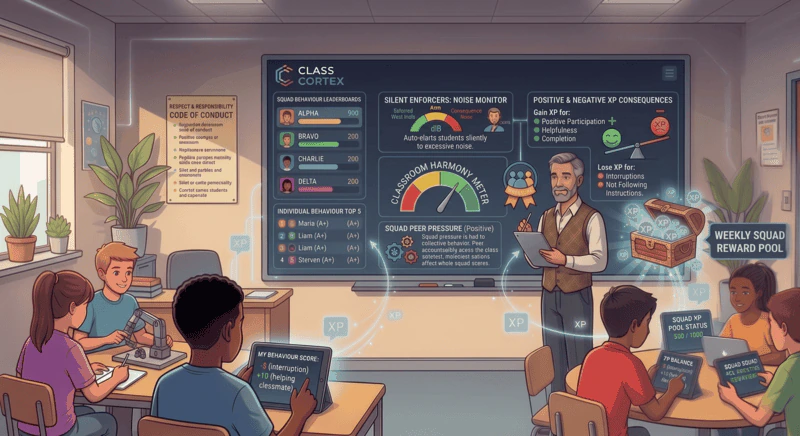
Manage classroom behaviour without shouting by moving enforcement from your voice to systems. Use a noise monitor that fires an alarm automatically, award XP live for positive behaviour, group students into teacher-assigned squads so peers self-regulate, and run visible timers through transitions. Consequences then land consistently and impersonally, saving your voice for teaching.
Every experienced teacher knows the arc. You start the year calm and controlled. You use proximity, wait time, the quiet look. It works for a while. Then a class arrives that tests the ceiling of those techniques, lesson after lesson, and somewhere around week six you find yourself raising your voice more than you intended. The class registers the escalation, briefly quietens, and then the baseline creeps back up. You have taught them that volume is a negotiation.
Shouting is not a behaviour management strategy. It is a symptom of a system that has run out of lower-cost options. The teachers who manage the most challenging secondary classes without raising their voice are not calmer by personality - they have built systems where the consequence fires automatically, consistently, and impersonally, without requiring teacher effort to administer. For a step-by-step version, read how to stop students talking over you without shouting.
This guide covers the practical architecture of that kind of system. It starts with the foundational techniques that belong in every secondary teacher's toolkit, then moves into the structural layer - the automated consequences and social dynamics that do the enforcement work so your voice does not have to. The full strategic picture of building a gamified management system is covered in How to Gamify Your Classroom Without Losing Control, but this post focuses specifically on the behaviour management mechanics.
Why Most Behaviour Management Advice Falls Short
The standard advice is not wrong. Proximity works. Consistent routines work. Clear expectations work. Positive framing works. If you are a pre-service teacher or in your first years of practice, building these skills is exactly the right focus.
The limitation is that all of these techniques require the teacher to be the active agent of enforcement. You notice the behaviour, you decide to respond, you choose the technique, you deliver it. Every intervention costs attention, time, and a fraction of your energy budget. In a class of 28 students across five periods a day, the cumulative cost is significant - and it scales directly with class difficulty.
The techniques in this guide are designed to complement the foundational skills, not replace them. The goal is to shift as much of the enforcement burden as possible from active teacher decision-making to automated systems and peer social dynamics - leaving your attention free for the actual teaching.
Strategy 1: Use the Noise Monitor as a Hands-Free Behaviour Signal
The most immediate upgrade available to any secondary teacher is a noise monitor that does something when noise crosses the threshold, rather than just changing colour on screen.
Most classroom noise monitors - including the one built into Classroomscreen - are display tools. They turn red when the room is loud. That information still requires the teacher to notice, pause, and intervene. The noise monitor has done nothing except give you a reading; the enforcement is still your job.
Class Cortex's Sonic Defence Engine works differently. Calibrate it to your room's ambient baseline on first use - it takes about five seconds - and from that point it monitors continuously. When classroom noise crosses your set threshold, it fires immediately: a visible alarm on screen, an audio cue, and on Pro, an automatic XP deduction from the class scoreboard. You do not need to notice it. You do not need to pause the lesson. You do not need to say a word. On the free tier the alarm and Quiet Streak reset alone create the peer pressure that shifts the dynamic away from teacher voice. For the full setup sequence, see how to set up a gamified classroom from scratch.
The effect on student behaviour is rapid and consistent precisely because the consequence is impersonal. Students cannot negotiate with an algorithm. They cannot argue that you misheard them, that it was someone else, or that you always single them out. The monitor fired because the room was too loud. That is the end of the discussion.
Noise Auto-Penalty Mode
Pro users can take this further with Noise Auto-Penalty mode, which operates completely hands-free throughout the lesson. The system monitors, detects, fires, and deducts without any teacher input required. Combined with the Quiet Streak tracker - which awards bonus XP to the class for every 30 seconds of sustained quiet - the noise system becomes a self-contained behaviour engine running in the background of every lesson. For a detailed breakdown of how the noise monitor compares to standalone tools, see Free Classroom Noise Monitor: Best Tools Compared.
The Impersonality Advantage
One of the most underrated benefits of automated consequences is that they remove the teacher from the conflict entirely. When the noise monitor fires and XP is deducted, the consequence came from the system - not from you. Students cannot argue that you are targeting them. They cannot accuse you of inconsistency. The monitor does not have favourites.
This shifts the student's emotional response away from resentment toward the teacher and toward the natural consequence of the system they agreed to operate within. That is a fundamentally healthier classroom dynamic - and it protects your relationship with the class while still enforcing the standard.
Strategy 2: Let the XP System Be Your Positive Consequence Engine
Most behaviour management systems focus heavily on consequences for disruption. The other half of the equation - positive reinforcement for compliance and performance - is just as important, and it is where the XP system earns its place.
The Command Deck in Class Cortex tracks individual XP and HP for every student, plus squad-level totals visible on the scoreboard. Every time you award XP - for a correct answer, a quality contribution, a quiet work period, a good start to the lesson - the scoreboard updates live. Students see the reward happen in real time. The connection between their behaviour and the outcome is immediate and visible.
This positive loop matters because it gives students a reason to maintain good behaviour beyond merely avoiding a consequence. A student who is three hundred XP behind the squad leader has a specific, visible goal to work toward. A squad sitting forty XP below the weekly target in the final lesson of the week has a concrete incentive to lift their collective performance. The system creates positive pressure alongside the negative consequence of noise deductions - both operating simultaneously, both impersonally, both without the teacher having to manage them manually.
The Neural Core Economy adds a purely individual version of that same loop. Students can spend their own banked XP unlocking avatars in the Achievements tab - a first tier is free for everyone, but everything past it costs XP, kept forever once bought even if XP is later reset. For a student who is not personally invested in the squad race, having something of their own to save up for still gives good behaviour an immediate, visible payoff.
HP as a Graduated Consequence
HP (hit points) functions as a graduated consequence layer sitting between XP deductions and more formal interventions. Persistent off-task behaviour, repeated noise threshold crossings, or specific disruptive acts can cost HP directly. Unlike XP deductions - which come from a collective pool - HP can be assigned individually, giving the teacher a precise tool for naming specific students without a public confrontation. The HP bar depleting on the scoreboard is visible to the class and to the student; the consequence is clear without requiring a verbal exchange.
Strategy 3: Build Peer-Enforced Norms Through the Squad System
The most powerful behaviour management force available to any secondary teacher is peer social pressure - and the squad system is how you structure it to work for you rather than against you.
When students are grouped into squads of four to six with a shared XP total displayed on the scoreboard, the social stakes of disruptive behaviour change fundamentally. A student who triggers the noise monitor is not just creating an abstract cost to the class - they are costing their specific squadmates points that those squadmates are tracking on the live scoreboard. The social accountability is immediate and peer-driven.
Secondary students respond to this dynamic more reliably than they respond to teacher authority for a simple reason: peer standing matters more to adolescents than adult approval. A student who would ignore a teacher's warning will often self-regulate when their squadmate turns and tells them to stop talking, because the social cost of disappointing their squad is real in a way that disappointing a teacher is not. The teacher has restructured the social incentives without needing to be the enforcer.
This only works if the squad system is structured correctly. Squads must be teacher-assigned - self-selected groups replicate existing friendship dynamics and create insular units rather than diverse teams with genuine cross-group investment. Squads should be stable enough for identity to form - at minimum four weeks, ideally a full term. And the scoreboard must be visible every lesson so the stakes remain salient. For the full tactical guide on running this system across a term, see How to Use Team Points in the Classroom.
Strategy 4: Use Visible Routines and Timer Pressure to Replace Verbal Instructions
A significant proportion of classroom behaviour management consists of transition management - the gaps between activities where noise rises, students drift off-task, and the teacher has to repeatedly redirect. These transitions are where many teachers find themselves reaching for their voice most often, and they are almost entirely preventable with the right structural tools.
The Class Cortex Arc and Detonator timers solve this at the display level. A countdown running on the projector from the moment students enter the room signals immediately that a task is active and time-bounded. Students who are already invested in the XP system know that the noise monitor is watching while the timer runs. No verbal instruction needed for either the time constraint or the expected volume level. For how they compare with other free timers, see our free classroom timer comparison.
Building predictable routines around these tools accelerates the effect. Within two to three weeks of consistent use, students enter the room, see the Arc timer running, and begin the starter task without prompting. The visual environment has trained the behaviour. The teacher's voice is preserved for actual teaching rather than managing transitions.
Strategy 5: Reserve Your Voice for Teaching, Not Managing
The cumulative effect of the strategies above is a shift in what your voice is used for. In a classroom where the noise monitor fires a visible alarm automatically, on Pro the XP scoreboard updates live with each breach, squad peer pressure manages social norms, and timers handle transitions - your voice is free for explanation, questioning, feedback, and relationship-building. These are the uses of teacher voice that actually improve learning outcomes.
Each strategy in this guide, the tool that runs it, and the teacher effort it takes off your plate.
| Strategy | Class Cortex tool | What it replaces |
|---|---|---|
| Hands-free noise signal | Sonic Defence noise monitor | Noticing and pausing to intervene |
| Positive consequence engine | Command Deck XP | Consequences with no positive payoff |
| Graduated individual consequence | Student HP bar | Public verbal confrontation |
| Peer-enforced squad norms | Squad XP scoreboard | Teacher as sole enforcer |
| Visible routines and timer pressure | Arc and Detonator timers | Verbal transition instructions |
This is the real argument for automated behaviour management systems. Not that they replace teacher skill, but that they protect it - keeping the most finite and valuable classroom resource reserved for the moments where a human being is genuinely irreplaceable.
The practical implementation of the full system - Command Deck setup, squad assignment, noise monitor calibration, timer integration, and the reward cycle that keeps it running all term - is covered in depth in the Classroom Reward System for Secondary School guide.
Noise monitor, XP system, squad scoreboard. Free, no student accounts required.
Frequently Asked Questions
How do you manage classroom behaviour without shouting?
The most effective silent behaviour management techniques work through systems rather than voice. A noise monitor that fires a visual alarm on breach - and on Pro, automatically deducts class XP when volume crosses a threshold - means the consequence fires without any teacher intervention. Squad peer pressure means students self-regulate because their squadmates are watching the scoreboard. Visible routines and a live countdown timer set behavioural expectations without announcements. The goal is to shift authority from your voice to the system running on screen.
What is the most effective classroom behaviour management strategy for secondary school?
For secondary students, the most effective strategies operate through peer social dynamics rather than teacher authority alone. Squad-based XP systems create peer-enforced norms - students manage each other's behaviour because the scoreboard is collective. Automated noise consequences remove the teacher from the enforcement loop entirely, making consequences consistent and impersonal. Visible progress toward earned privileges gives students a positive reason to maintain behaviour rather than just avoiding a negative outcome.
How does an automated noise monitor help with classroom behaviour?
An automated noise monitor like Class Cortex's Sonic Defence Engine calibrates to your room's baseline and fires a consequence the moment noise crosses the threshold - a visual alarm and audio cue on the free tier, plus automatic XP deduction on Pro. The teacher does not need to notice, pause the lesson, or issue a verbal warning. The consequence is immediate, consistent, and impersonal. Pro users can enable full Noise Auto-Penalty mode for completely hands-free volume management throughout the lesson.
How does squad peer pressure improve classroom behaviour?
When students are grouped into squads with a shared XP total visible on the scoreboard, individual disruptive behaviour carries a collective cost. A student who triggers the noise monitor is costing their entire squad - and their squadmates know it. This peer accountability is more powerful than teacher authority for many secondary students because it operates through social identity and belonging rather than top-down enforcement. The teacher does not need to say anything; the squad dynamic does the work.
Does Class Cortex require student devices for behaviour management?
No. The core behaviour management system in Class Cortex - XP and HP scoreboard, noise monitor, squad system, and timers - runs entirely on the teacher's device projected onto the classroom screen. Students do not need their own devices for any of this. Devices are only used by students during Boss Battles, where they join at classcortex.com/join via QR code with no account or app required.
Further Reading