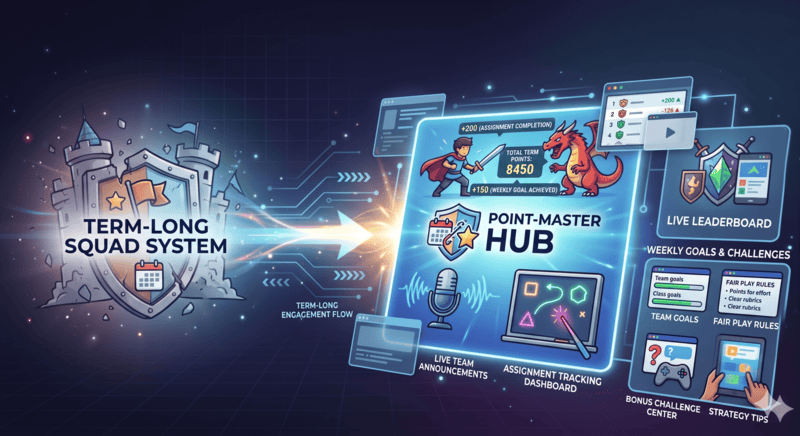
The concept is simple and every teacher has had some version of it. Divide the class into teams. Award points for good work and behaviour. The winning team gets a reward at the end of the week. Group competition motivates students in ways individual rewards often cannot - the social stakes of letting your team down are real, and the shared goal creates a collective energy that a solo leaderboard rarely generates. For how to display the standings, see our free classroom leaderboard guide.
And then, somewhere between week two and week four, it falls apart. The tally on the whiteboard gets wiped by accident. You forget to award points during a hectic lesson. One squad pulls ahead so far that the others stop trying. The reward at the end of the week stops feeling worth the effort. By mid-term the system has quietly died, and you have spent three weeks managing something that no longer works.
This is not a failure of the idea. Group competition genuinely works for secondary students. It is a failure of implementation - specifically, of the infrastructure needed to keep a points system alive across a full ten-week term. This guide covers that infrastructure: how to structure squads, what makes scoring persistent and credible, how to prevent dominant squads from killing the competition, and what rewards keep students invested week after week. If you want the broader reward system context that team points sit inside, the Classroom Reward System for Secondary School guide covers the full picture.
Why Classroom Team Points Systems Fail
Before building the system, it is worth being precise about the failure modes. They fall into three categories, and a well-designed system addresses all three explicitly.
The Data Problem
Whiteboard tallies get wiped. Spreadsheets fall behind and become inaccurate. Sticky notes on the board disappear. Any system where the data lives outside a persistent, automatically-saving tool is a system that will eventually lose its data - and when that happens, student trust in the fairness of the competition collapses instantly. If students believe the scores are wrong or arbitrary, they disengage.
The Consistency Problem
Teacher-administered point systems require the teacher to remember to update them mid-lesson, accurately, consistently, while also teaching. On a good day with a cooperative class, this is manageable. On a difficult day with a challenging class - exactly when consistent consequences matter most - it is the first thing that gets dropped. A system that requires teacher memory to function will eventually become inconsistent, and inconsistency is fatal to the perceived fairness of a competition.
The Balance Problem
Most team point systems have no mechanism for keeping the competition genuinely competitive across the full term. One squad pulls ahead in week two. The gap widens. By week five, the trailing squads have no realistic path to winning and no reason to keep trying. The competition is effectively over before the halfway point, but the teacher keeps running it anyway while students mentally opt out.
A system that solves all three of these problems is one that can last a full term. The steps below address each one directly.
Step 1: Assign Squads Deliberately
Squad assignment is where the entire term-long competition is won or lost - and it happens before a single point is awarded. Get this wrong and no amount of good system design will save you.
The first rule is that squads must be teacher-assigned, not self-selected. Self-selected groups replicate existing social hierarchies. The popular students cluster together. The academically strong form their own unit. The socially marginalised end up in whatever squad is left over. The resulting competition is neither balanced nor fair, and students know it within a week.
Teacher assignment lets you distribute deliberately. Aim for each squad to have a mix of high-engagement and lower-engagement students, a spread of academic performance levels, and no obvious social clustering. You are building teams designed to be competitive with each other, not reflecting the social order that already exists.
Squad size matters. Four to six students is the optimal range. Fewer than four and the squad feels thin - a single absence significantly affects the daily scoring potential. More than six and individual accountability weakens; students feel their personal contributions become less meaningful within the larger group. For a class of 28, six squads of four to five is the standard configuration.
Name Your Squads
This step is easy to skip and worth not skipping. Named squads develop identity faster than numbered or lettered ones. Students who identify as DELTA squadron engage with competition in a qualitatively different way from students who are on "Group 4." Class Cortex uses six tactical designations - ALPHA, BRAVO, CHARLIE, DELTA, ECHO, FOXTROT - which land well with secondary students without being juvenile. Whatever names you use, commit to them for the term and use them consistently.
Step 2: Make the Scoreboard Visible Every Single Lesson
The scoreboard is not a weekly summary. It is a live presence in every lesson, from the moment students enter the room to the moment they leave. This is the single most important operational rule of any team points system, and it is the one most often violated by teachers who underestimate how much of the system's power comes from continuous visibility.
When students can see the standings in real time, their behaviour connects directly to the outcome. A student who earns XP sees the squad bar move. A student whose noise triggers the monitor sees the alarm fire - and on Pro, sees XP deducted. The cause-and-effect loop is immediate and concrete. Remove the scoreboard from view - even for a few lessons - and that connection weakens. By the time you bring it back, some students have mentally disengaged.
This is the practical reason why a whiteboard tally fails even when teachers are disciplined about updating it: it requires deliberate setup and is easily obscured or wiped. The scoreboard needs to be the default state of your classroom display, open on the projector at the start of every lesson automatically and requiring no setup time to maintain.
Persistent by Default
Class Cortex's Command Deck saves all XP data automatically in browser localStorage between sessions. Open the app at the start of the lesson and the scoreboard is exactly where you left it - squad totals, individual XP, weekly goal progress, all current. There is no save button. There is no spreadsheet to update. The system persists by default.
Combined with the Sonic Defence noise monitor (Quiet Streak bonus XP on the free tier, automatic XP deduction on Pro), the scoreboard stays live and accurate throughout every lesson without any teacher input required to maintain it. That is the infrastructure that makes the system survivable across a full term.
Step 3: Run Individual and Squad XP Together
A common design mistake is running squad points as a purely collective system where only team-level scores exist. This removes individual accountability - students can free-ride on their squadmates' performance without personal cost - and it removes the personal progression hook that keeps individuals invested day to day.
The more effective structure tracks both simultaneously. Every student has individual XP that accumulates across the term, reflecting their personal performance and contributions. Individual XP feeds into the squad total - so personal effort has a direct squad consequence - but it also exists independently, giving students a personal progression track alongside the team competition.
This dual structure serves different students. Highly competitive students are motivated by both the individual standings and the squad race. Students who are less competitive individually often remain engaged through squad loyalty even when their personal rank is not remarkable. Students who are primarily extrinsically motivated stay active because their squad total is affected by what they do. The combined system captures a wider range of motivational profiles than either structure alone.
For a detailed breakdown of designing the individual XP layer, see the XP in the Classroom practical guide.
Step 4: Set Weekly Goals Alongside the Competition
Pure head-to-head competition between squads has a structural weakness: it only rewards the winner. Every lesson, five squads are losing. Students in trailing squads have a diminishing incentive to stay engaged the further behind they fall.
Adding a weekly class-wide XP goal alongside the relative competition changes the incentive structure. If the entire class hits the weekly XP target, every squad earns the associated reward - regardless of their relative standing. This creates an absolute target that all squads can achieve simultaneously, alongside the relative competition where only one squad can lead.
The result is that students in trailing squads have two reasons to keep contributing: they are still working toward the collective class goal even if the squad race is not going their way. The competition stays alive for more students for more of the term.
Weekly goals also give the teacher a natural rhythm for reward delivery. End of week: did we hit the goal? If yes, the reward fires - a Boss Battle session, a Training Sim choice, music-on work time. The squad leader gets an additional privilege. Both outcomes are acknowledged. The cycle resets for the following week.
Step 5: Prevent Dominant Squads From Killing the Competition
Even with deliberate squad assignment and balanced scoring, one squad will occasionally pull significantly ahead. Left unaddressed, a large gap by week four means the competition is effectively over for everyone else - and once students stop believing the outcome is in play, engagement drops sharply.
Several structural tools help maintain competitive balance without feeling arbitrary or punishing success.
Weighted Catch-Up Opportunities
Design specific XP events - Training Sim completions, Boss Battle performance bonuses, quiet streak awards - that give all squads regular high-value opportunities to close gaps quickly. These should be available to every squad simultaneously, so trailing squads can surge if they perform well without the leader being penalised.
Mid-Term Soft Reset
At the halfway point of the term, consider carrying forward 50 to 70 percent of accumulated squad XP rather than maintaining the full gap. This acknowledges the leader's earned advantage while making the final half of the term genuinely competitive for squads that have closed the performance gap but are still behind on accumulated points. Done transparently and announced in advance, students accept it as a design feature rather than arbitrary interference.
Term-End Reassignment
At the end of each term, reassign squads entirely. This prevents the social stratification that builds up over time, gives every student a fresh competitive start, and creates a natural cycle that keeps the system feeling live rather than settled. The previous term's standings inform the new assignment - distributing top performers across new squads to ensure balance - but no accumulated advantage carries forward.
Step 6: Connect Team Points to Earned Privileges
The reward cycle is what makes team points feel worth earning. Without a visible, meaningful payoff, even a perfectly designed competition loses its motivational pull by mid-term. Secondary students need to believe the stakes are real.
The most effective rewards for squad competition at secondary level are activity-based rather than tangible. A Boss Battle session - where students join on their own devices at classcortex.com/join via QR code, answer questions to deal damage to a boss, and compete in real time - is the single most requested reward in classrooms using Class Cortex. It is also the one that most directly demonstrates the value of the whole system: students earn their way into one of the most engaging activities in the classroom by accumulating squad XP. For the full guide on running Boss Battle sessions, see How to Run a Boss Battle in Your Classroom.
Other rewards that work consistently: the leading squad choosing the next Training Sim game, music-on work sessions unlocked when the class hits the weekly XP goal, and seat choice for the following lesson awarded to the individual week leader. Keep the reward cycle weekly so students always have a short-term target in view, and term-end recognition for the overall squad champion to give the longer competition genuine stakes. For a ready-made, no-prep structure, see our free classroom reward system.
Up to six squads, live XP scoreboard, weekly goals. Free, no student accounts required.
Frequently Asked Questions
How do you run a team points system in the classroom?
Assign every student to a teacher-selected squad of four to six members. Give each squad a name and a shared XP bar visible on screen every lesson. Award individual XP for performance; individual XP feeds into the squad total automatically. Set a weekly class-wide XP goal. Display standings every lesson without exception. Class Cortex's Command Deck handles all of this with six named squads, persistent localStorage tracking, weekly goals, and a live scoreboard - free, no student accounts required.
How do you stop one squad from dominating the entire term?
Balance squads on assignment by distributing high-engagement and lower-engagement students across all teams. Set weekly XP goals that reward all squads hitting the target - shifting some competition from relative to absolute. Consider a mid-term soft reset carrying forward 50 to 70 percent of accumulated XP, giving trailing squads a catchable gap without erasing earned progress. Reassign squads at term end with new groupings to restart on level ground.
Should squads be self-selected or teacher-assigned?
Teacher-assigned, always. Self-selected squads replicate existing friendship groups, create unbalanced teams, and often result in socially dominant squads pulling ahead early and never being caught. Teacher assignment lets you balance academic performance, engagement levels, and social dynamics intentionally - building teams designed to be competitive with each other rather than reflecting the social order that already exists.
How many students should be in a classroom squad?
Four to six students is the optimal squad size. Fewer than four and the squad feels thin - one absence makes a noticeable difference. More than six and individual accountability weakens. For a class of 28 to 30, six squads of four to five is the standard configuration. Class Cortex supports 2 to 6 squads - ALPHA through FOXTROT, four by default - so you can size them to your class roll.
What rewards work best for a classroom squad points system?
The most effective squad rewards involve choice or experience rather than physical objects. Options that work well for secondary students include: the leading squad choosing the next Training Sim game, triggering a Boss Battle session when the weekly XP goal is hit, music-on work time earned by collective quiet achievement, and seat choice awarded to the top squad. Rewards should feel meaningfully tied to squad performance - not handed out arbitrarily.
Further Reading