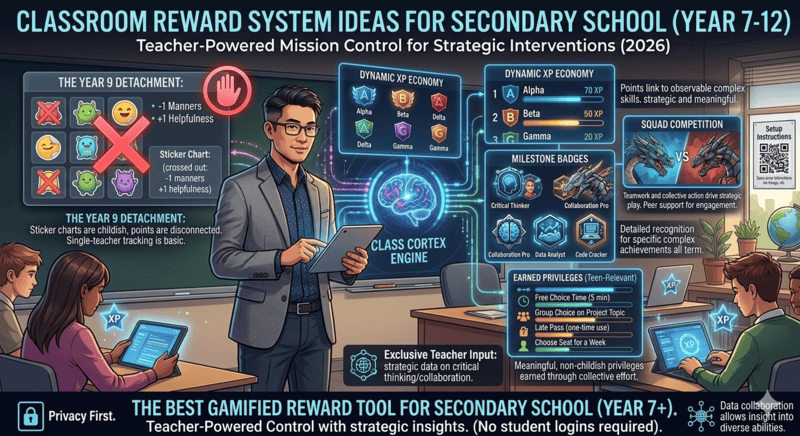
Search for classroom reward system ideas and most of what you find is written for primary school teachers. Sticker charts. Marble jars. Token boards. Treasure boxes. Star of the week certificates. All of it designed for students who are seven years old and genuinely delighted by a gold star next to their name.
Secondary teachers know the problem. Year 9 students are not impressed by stickers. Year 11 students will openly mock a marble jar. The reward systems that work brilliantly in primary settings collapse in secondary classrooms not because secondary students do not respond to rewards - they absolutely do - but because the type of reward matters enormously once students are adolescents with developed social identities and a strong sense of what is and is not beneath them.
This guide is written specifically for upper primary and secondary teachers - Years 5 through 12 - who want a reward system that earns genuine buy-in, sustains engagement across a full term, and does not require you to carry a bag of stickers to work. It covers the principles behind what works at this age, the specific structures that hold up over time, and how to implement them with or without digital tools.
Why Primary Reward Systems Fail in Secondary Classrooms
The core issue is not that adolescents lack motivation - it is that they are acutely attuned to social signalling. A reward that feels childish or arbitrary does not just fail to motivate; it actively damages your credibility with the class. A Year 9 student who watches you pull out a sticker chart on week one has already decided this is not a teacher who understands them.
Secondary students respond to rewards that carry three specific qualities:
- Earned, not given. The reward must feel like the result of genuine performance, not a participation prize. XP tied to correct answers and quality contributions feels earned. A sticker for sitting quietly does not.
- Persistent and visible. Progress that disappears at the end of the lesson is progress that students stop investing in. A scoreboard that carries across every lesson, every week, builds accumulated stakes that primary-style daily resets cannot match.
- Social without being embarrassing. Competition works for secondary students - but only if it operates at the group level rather than the individual level. Squad-versus-squad competition lets students compete without singling out individuals for public praise or shame, which secondary students find mortifying in equal measure.
Every effective secondary reward system - whether analogue or digital - succeeds because it meets these three criteria. The structures below are built around them.
Step 1: Build an XP Economy
The XP (experience points) model works for secondary students for the same reason it works in video games: it converts abstract effort into visible, accumulating progress. Students always know where they stand. The gap between where they are and the next threshold is always visible. The system rewards consistency rather than single performances.
Setting up an XP economy for your classroom involves four decisions:
Define Your XP Events
Decide upfront which behaviours and performances earn XP. The list should be short enough to remember and clearly tied to things you actually value. Common XP events for secondary classrooms include correct answers during class questioning, quality contributions to discussion, on-task work during a timed activity, a quiet start to the lesson with no redirection needed, and completing extended tasks within the set time. Less effective are participation points that can be gamed easily or XP awarded for things students would do anyway - keep the award meaningful.
Set Individual and Squad Targets
Individual XP tracks each student's personal progress. Squad XP aggregates the individual contributions of four to six students into a team total visible to the whole class. Both matter. Individual XP gives students personal investment; squad XP gives them a social reason to maintain it even when they are tired or disengaged. A student who is not particularly motivated for themselves will often stay on task to avoid costing their squad points.
Make It Visible
An XP system that students cannot see is not an XP system - it is a spreadsheet. The scoreboard needs to be projected on screen every lesson. Not occasionally. Every lesson, from the moment students enter the room. Visibility is what gives the system its behavioural power. For a detailed walkthrough of implementing XP structures in the classroom, see the XP in the Classroom practical guide.
Decide on Negative Consequences
XP economies work best when there is a cost for disruptive behaviour, not just a reward for compliance. HP (hit points) that deplete for repeated noise or off-task behaviour creates a loss-aversion dynamic that is often more motivating than the prospect of gains. The key is that consequences must be automatic, consistent, and proportionate - any system that relies on the teacher remembering to manually deduct points will eventually be forgotten and lose credibility.
XP Without the Admin Overhead
The biggest reason XP systems die mid-term is the admin burden. Updating a spreadsheet after every lesson, manually tracking squad totals, remembering to award points during a lesson you are also trying to teach - it compounds fast.
Class Cortex's Command Deck handles all of it automatically. Individual XP and HP per student, six squad slots each with their own XP bar, weekly goals, automatic noise-triggered XP deductions via the Sonic Defence monitor on Pro (free tier: visual alarm and Quiet Streak bonus XP), and persistent localStorage saving between sessions with no manual input required. The system runs in the background while you teach.
Step 2: Structure Squad Competition
Squad competition is the most powerful engagement mechanic available to secondary teachers because it converts individual classroom behaviour into a collective social stake. When a student realises that their noise level or off-task behaviour is costing their squad points - and their squad members are watching the scoreboard - peer pressure becomes an ally rather than an obstacle.
Effective squad systems for secondary classrooms share several structural features. Squads should be small enough to feel cohesive - four to six students is the right range. They should be teacher-assigned rather than self-selected, at least initially, to avoid the social dynamics of friend groups dominating and isolating others. Squad membership should be stable enough to build genuine team identity - reassigning squads every week removes the accumulated investment that makes competition meaningful.
Name your squads. This sounds trivial but it is not. A class where students identify as ALPHA, BRAVO, and DELTA squadron engages with the competition differently from one where they are on "Table 3." The naming creates an identity layer that the competition can attach to. Class Cortex uses six tactical squad designations - ALPHA through FOXTROT - which land well with secondary students without being juvenile.
Display squad standings every lesson. The live scoreboard should show where each squad sits relative to the others and relative to the weekly XP goal. Students check it when they enter the room. They check it after every significant XP event. That visibility is what keeps the competition alive across a full term rather than peaking in week two and fading. For a full guide on running squad point systems across a term, see How to Use Team Points in the Classroom.
Step 3: Install Milestone Badges
Milestone badges solve a specific problem that pure XP economies create: once students reach a stable position in the standings, the urgency to keep earning can fade. Badges give students something to chase beyond the leaderboard - achievements at fixed XP thresholds that mark genuine progress and accumulate visibly in their profile.
The most effective badge systems for secondary students are tiered, named, and slightly aspirational. A student who earns the first badge on day three has a short-term goal accomplished and immediately has a new threshold to aim for. A student who is three badges behind their squadmates has a visible, specific gap to close. The badge acts as a waypoint on a longer journey rather than the destination itself.
Class Cortex includes CC-Achieve milestone badges at meaningful XP thresholds - named achievements that accumulate in the Command Deck alongside individual XP totals. Students can see their own badge progression and compare it with squadmates. The system requires no teacher setup beyond the initial class creation; badges unlock automatically as XP thresholds are crossed.
The Neural Core Economy adds a second individual pull alongside badges - students spend their own banked XP unlocking avatars in the Achievements tab, rather than just watching a badge count climb. A first tier of avatars is free for everyone, but everything beyond it costs XP, and a purchased avatar is kept for good even through an XP reset. For an age group that responds to autonomy and personal identity far more than to a gold star, spending on your own avatar carries a different weight than banking points for a squad total.
Step 4: Gate High-Value Rewards Behind Collective Achievement
The most powerful reward a secondary classroom can offer is one that students have collectively earned and are genuinely excited to spend. Privilege rewards - particularly those involving choice, activity, or experience - outperform tangible prizes at this age group because they feel like recognition of performance rather than a transaction.
Effective privilege rewards for Year 7 through 12 include:
- Boss Battle session - a live multiplayer classroom game where students join on their own devices, answer questions to deal damage to a boss, and compete in real time. The most engaging ten minutes in any lesson and a reward students actively push toward. Students join at classcortex.com/join via QR code with no account or app required.
- Neural Training Simulator choice - the leading squad gets to choose which of the eight built-in classroom mini-games the class plays next: DATA_BREACH for typing speed, SECTOR_MATH for mental arithmetic, MAINFRAME_HACK for logic puzzles, or CIPHER_PROTOCOL for code-breaking.
- Seat choice for the lesson - earned by the top individual XP earner of the week. A small privilege that lands disproportionately well with secondary students who value autonomy.
- Music-on work session - the class earns a quiet, focused work session with ambient background audio playing. Particularly effective as a weekly class-wide goal reward.
- Squad assignment vote - the leading squad for the term gets input on squad reassignment at the end of the term. Gives high-performing students a structural stake in the next cycle of the competition.
The common thread is that these rewards involve a meaningful experience or choice, they are clearly tied to performance, and they are things students actually want rather than things adults think students should want.
Step 5: Keep the System Alive Past Week Three
Most reward systems do not fail because the design is wrong. They fail because the implementation collapses under its own maintenance burden. By week three, the manual spreadsheet is two lessons behind, the teacher has forgotten to award several XP events, students have noticed the inconsistency, and the social contract that the system depends on has quietly dissolved.
Three things prevent this. First, the XP system must persist automatically between sessions without teacher action. If saving the data requires a deliberate step, it will eventually be skipped. Second, at least one consequence - the noise penalty - should operate without teacher input. On Pro, the Sonic Defence noise monitor handles this automatically; on the free tier the visual alarm and Quiet Streak still create peer pressure without the deduction being automatic. Automated consequences are consistent by definition. Third, the scoreboard must be visible every single lesson without the teacher having to set it up. If opening the scoreboard takes more than three seconds, it will stop happening reliably.
Class Cortex is designed around these requirements. Data persists in browser localStorage with no save action required. On Pro, the Sonic Defence noise monitor deducts XP automatically when the threshold is crossed; on the free tier the visual alarm and Quiet Streak bonus XP run automatically. The dashboard opens at the last session state instantly on page load. The system is designed to run with minimal friction because low-friction systems are the ones that survive a full ten-week term.
Putting It Together: A Term-Long Reward System
A complete secondary classroom reward system running across a full term looks like this. Students arrive and the scoreboard is already visible on the projector - squad standings, individual XP, weekly goal progress. The lesson runs. XP is awarded for performance. The noise monitor fires a visual alarm and Quiet Streak XP on breach; on Pro, XP deducts automatically. At the end of the week, the leading squad earns the privilege reward. Mid-term, CC-Achieve badges unlock as students cross XP thresholds. At the end of term, the final standings are recognised, squads may be reassigned, and the new term's goals are set.
That cycle - visible progress, consistent consequences, meaningful milestones, earned privileges - is what separates a reward system that lasts a term from one that collapses in week three. For teachers who want the full picture of gamifying classroom management at the secondary level, the How to Gamify Your Classroom Without Losing Control guide covers the broader strategy in depth.
XP, squads, badges and Boss Battles. Free, no student accounts required.
Frequently Asked Questions
What reward systems work best for secondary school students?
Secondary students disengage quickly from primary-style rewards like sticker charts and marble jars. What works at Year 7 through 12 is a persistent XP economy with visible progress, squad-based competition that creates peer investment, milestone badges that mark genuine achievement, and earned privileges like Boss Battle sessions tied to hitting weekly goals. The key is a system that persists across lessons rather than resetting each day.
How do you set up an XP reward system in the classroom?
Start by assigning every student individual XP and HP tracked on a visible scoreboard. Define when XP is awarded - correct answers, on-task behaviour, quality contributions, quiet streaks. Group students into squads of four to six so individual XP feeds into a team total. Set a weekly XP goal for the class. Class Cortex's Command Deck implements this entire structure with persistent tracking, six squad slots, weekly goals, and CC-Achieve milestone badges - all free, no student accounts required.
Do reward systems work for older secondary students like Year 10 and 11?
Yes, but the framing matters. Years 10 and 11 students disengage from anything that feels childish or arbitrary. What works is a system that feels earned rather than given - XP tied to demonstrable performance, milestone badges at meaningful thresholds, and privileges like bonus activity time or Boss Battles unlocked by hitting genuine goals. The game structure provides engagement; the performance link provides credibility.
What are good classroom privilege rewards for secondary students?
Effective privilege rewards for secondary students include choosing their seat for the lesson, selecting the next Neural Training Simulator game, triggering a Boss Battle session, earning music-on working time, or choosing squad assignments for the following week. The common thread is that privileges should involve a meaningful choice or experience, not a physical object, and should feel like a genuine unlock tied to real performance.
How do you keep a classroom reward system running all term without it dying off?
Three things kill reward systems before the end of term: the data gets lost, the teacher forgets to update it, and students stop believing their actions change the outcome. Class Cortex solves all three - XP persists automatically in browser localStorage between sessions with no manual saving, the noise monitor auto-deducts XP without teacher input on Pro (free tier: visual alarm and Quiet Streak XP), and the live scoreboard visible every lesson means students always know where squads stand. Consistency of visibility is what keeps the system alive across a full ten-week term.
Further Reading