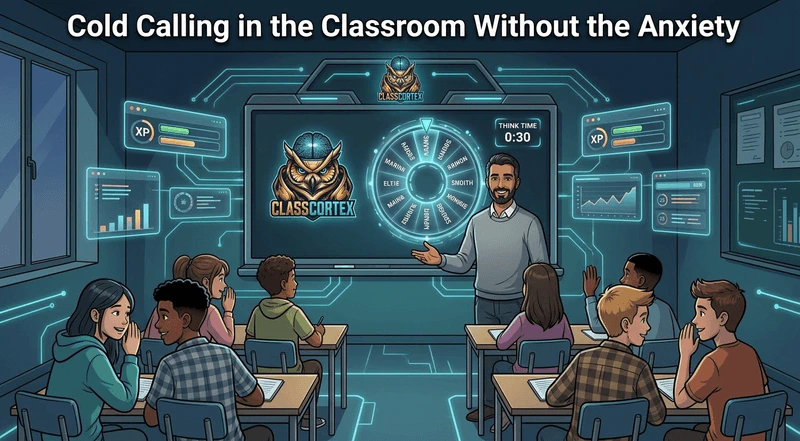
Cold call well by asking the question first, giving everyone think time, letting students rehearse with a partner, then choosing at random so nobody feels singled out. Value the attempt over the right answer, offer a lifeline, and protect students with genuine anxiety. Done this way, research links cold calling to more voluntary participation, not less.
Ask a question with hands up and the same five students answer it. Everyone else learns, very quickly, that they can opt out of thinking. Cold calling, choosing who answers rather than waiting for volunteers, fixes that. It is one of the most effective questioning habits a teacher can build, and one of the most criticised.
The criticism is fair when cold calling is used to catch out a student who is not paying attention. But that is a choice about how it is done, not a flaw in the idea. This guide covers what the research actually says, then six practical steps for cold calling in a way that keeps the whole class thinking without making anyone dread the next question.
What Is Cold Calling in the Classroom?
Cold calling means the teacher chooses which student answers, instead of taking a volunteer. Doug Lemov's Teach Like a Champion made "Cold Call" one of the best-known techniques in teacher training, with the emphasis on making it a normal, predictable routine rather than a gotcha. Paired with a "no hands up" rule, it changes the question from "who wants to answer?" to "everyone needs an answer ready".
The practical effect is on who speaks. Research summarised by Edutopia notes that teachers tend to call on the same students repeatedly, often skipping shy students or those they assume already know the answer. A deliberate cold calling routine spreads the questions across the whole room.
What the Research Says About Cold Calling
The evidence points both ways, and the difference is how it is done.
- It can increase participation. In a study of college classes by Dallimore, Hertenstein and Platt (2013), classes with frequent cold calling had significantly more students answering questions voluntarily, that number grew over the course, and students' comfort with participating rose. In classes with little cold calling, comfort did not change.
- It can also raise anxiety. In interviews with 52 undergraduate science students, Cooper, Downing and Brownell (2018) found cold calling and random calling were the practices students linked most clearly to increased anxiety, driven mainly by fear of being judged negatively in front of their peers.
- The teacher's approach decides which one you get. A 2022 study of 15 teachers in four middle schools found two styles of cold calling: "encouraging and engaging" on one hand and "confrontational and intimidating" on the other. The warm style checked understanding and produced discussion where students felt safe to take risks; the confrontational style created anxiety and only superficial engagement (summarised in Edutopia's review of the research).
The same review highlights the habits that reduce anxiety: valuing every response, focusing on effort, giving longer wait time, and letting students back out of a call when they genuinely need to. Those habits are the backbone of the steps below.
How to Cold Call Without the Anxiety: Six Steps
| Step | What it does | Class Cortex tool | Plan |
|---|---|---|---|
| 1. Question first, name second | Everyone thinks, not just one | None needed | Free |
| 2. Think time on the clock | Removes the rush to answer | Arc timer | Free |
| 3. Rehearse in pairs | Nobody answers cold and alone | Think Pair Share template | Free |
| 4. Pick at random | Fair and visibly unbiased | Personnel Picker | Free |
| 5. Reward the attempt | Effort counts, not just accuracy | XP +10 | Free |
| 6. Protect genuine anxiety | Opt-out nobody else sees | Picker Exempt | Free |
Step 1: Ask the Question First, Then Say the Name
"Jordan, what is the main cause of..." lets everyone except Jordan stop thinking. "What is the main cause of...? Take a moment... Jordan." keeps the whole room working until the name arrives. Ask the question, pause, then call the student by name, with eye contact and a warm tone. This single habit does more than any tool.
Step 2: Give Think Time on the Clock
Most teachers wait about a second before calling on someone. The research summarised by Edutopia suggests pausing about 5 to 15 seconds, and links longer wait time to longer student answers and more volunteers. A visible countdown makes the pause feel deliberate rather than awkward: put 30 seconds on the Arc timer, say "everyone needs an answer when this ends", and let the clock hold the silence for you.
Step 3: Let Students Rehearse With a Partner
Nobody should be cold called on a question they have never had a chance to say out loud. A quick turn-and-talk first means the student you pick is sharing what they and their partner already discussed, which takes most of the fear out of it. The free Think Pair Share template on the Class Cortex whiteboard gives the routine a visible structure. Pair talk gets loud, so many teachers keep the Sonic Defence Noise Monitor running: on the free tier it fires a visual alarm and awards Quiet Streak XP when the room settles, and on Pro it can also deduct class XP automatically when noise crosses the line.
Step 4: Pick at Random, Visibly
When the teacher chooses, students wonder why it was them. When a random picker chooses on the big screen, the answer is obvious: it was the picker. That removes any sense of being targeted and stops you unconsciously returning to the same reliable students.
In Class Cortex, the Personnel Picker draws from your class roster, and with Auto-Remove switched on each student leaves the pool once picked, so there are no repeats until everyone has had a turn. Our guide to the free random student picker compares it with Wheel of Names and other options.
Step 5: Reward the Attempt, Not Just the Right Answer
If only correct answers are praised, a cold call becomes a test that some students expect to fail. Thank the student for the thinking, build on the part that was right, and treat a wrong answer as useful information for the class. Offer a lifeline when a student is genuinely stuck: ask a partner to help, or say "I will come back to you" and then actually do. If you use classroom XP, a +10 for a thoughtful attempt makes the message concrete. Our guide to classroom XP points covers a simple rate card.
Step 6: Protect Students With Genuine Anxiety
For most students, the steps above are enough. For a small number with genuine anxiety about speaking in front of the class, being picked at random still feels like a countdown with no way out. Talk to the student privately, agree on how they will contribute instead, and use Picker Exempt in Class Cortex: an exempt student is never actually chosen, but the picker's on-screen scramble still cycles through every name, so the rest of the class cannot tell anyone has been excluded. It is free and set per class.
Tools That Support Warm Cold Calling
- Arc timer: a visible countdown for think time, free.
- Think Pair Share template: a free whiteboard structure for pair rehearsal before you call on anyone.
- Personnel Picker: random picks from your roster, with Auto-Remove for no repeats until everyone has had a turn.
- Picker Exempt: quietly keeps students with genuine anxiety out of the draw while the scramble still shows every name.
- Class XP: +10 for a thoughtful attempt, so effort visibly counts.
Common Cold Calling Mistakes
- Using it as a trap: calling on the student who is clearly not listening turns cold calling into a punishment, and the whole class learns to fear it.
- Saying the name first: everyone else stops thinking the moment they know it is not them.
- No wait time: calling on someone a second after the question rewards speed, not thinking.
- Only praising correct answers: students stop risking an answer they are unsure of.
- Inconsistency: cold calling some lessons and taking hands up in others means students never settle into the routine.
Making Cold Calling a Normal Routine
The biggest predictor of whether cold calling feels safe is whether it feels normal. Explain the routine at the start of term, tell students why you do it (so everyone gets to think and nobody gets left out), and use it every lesson in the same way. Once students know that every question might come to them, that they will get time to think and a partner to check with, and that a wrong answer will not be held against them, cold calling stops being something to fear and becomes how the class works. For more ways to build that kind of participation, see our guide to student engagement strategies for secondary school.
No student accounts. No credit card. No install.
Frequently Asked Questions
What is cold calling in teaching?
Cold calling is when the teacher chooses which student answers a question, rather than taking volunteers with hands up. Used well, it keeps every student thinking because anyone might be asked, and it spreads questions across the whole class instead of the same few confident students.
Is cold calling bad for students with anxiety?
It can be when it is used to catch students out. Research links cold calling to increased anxiety, mainly fear of being judged by peers, but also finds a warm, encouraging approach reduces that. Think time, pair rehearsal, valuing every attempt and a private opt-out for students with genuine anxiety make a big difference.
How long should wait time be before cold calling?
Research summarised by Edutopia suggests pausing about 5 to 15 seconds after asking a question before calling on a student. Longer wait time is linked to longer answers and more volunteers. A visible countdown timer makes the pause feel deliberate rather than awkward.
What is warm calling?
Warm calling is a gentler version of cold calling where students are prepared before they are asked, for example by discussing the question with a partner first or being told in advance that they will be asked to share. It keeps the participation benefits of cold calling while reducing the anxiety of answering on the spot.
How do I stop calling on the same students?
Use a random student picker that removes each student from the pool once they have been picked, so nobody is asked twice until everyone has had a turn. In Class Cortex this is the Personnel Picker with Auto-Remove switched on, and it is free with no student accounts.
Further Reading