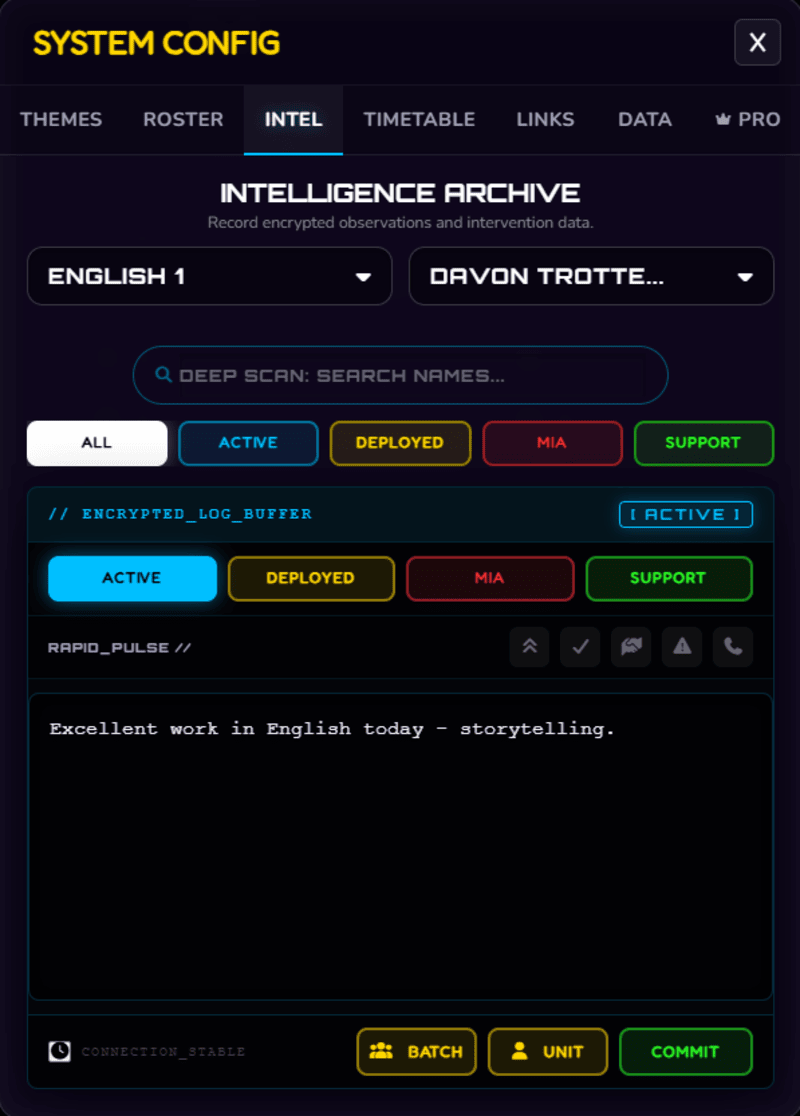
Intel Archive is the Settings > Intel tab for logging student status and time-stamped behaviour notes, with a PDF dossier export for one student or the whole class.
Intel Archive lives inside Settings, as its own INTEL tab alongside Roster and Schedule - it is not a floating panel of its own. Select a class and a student from the two dropdowns at the top, and the log below becomes editable: a running, time-stamped text record for that student, with five Rapid Pulse buttons for dropping in a common note type without typing a full sentence mid-lesson.
This guide covers student status, Rapid Pulses, searching and filtering the archive, and generating a PDF dossier for a student or the whole class. Badge and avatar rewards live in Command Deck's own Achievements tab, not here - see the Command Deck guide for that.
What Intel Archive Does
Each student can be set to one of four status tags - ACTIVE, DEPLOYED, MIA, or SUPPORT - using the buttons above the log. This is a manual, teacher-set label rather than anything automatically tracked, and it is what the ALL/ACTIVE/DEPLOYED/MIA/SUPPORT filter buttons above the class and student selectors filter by.
The five Rapid Pulse buttons - Exceeded Expectations, Task Accomplished, Requires Support, Protocol Violation, and Comms Established (for a parent or guardian contact) - each drop a time-stamped line straight into the log textarea in one tap, which then autosaves. You can also type freely in the log itself, or use the timestamp button to insert just the date and time without a preset label attached.
How to Use Intel Archive: Step by Step
Logging a note and pulling a dossier takes four steps.
- Select a class and student
Use the two dropdowns at the top of the Intel tab to pick a class, then a student from that class's roster - the log stays disabled until both are selected.
- Set a status if it has changed
Click ACTIVE, DEPLOYED, MIA, or SUPPORT to set that student's current status - this also updates what shows up when you filter the archive later.
- Log a note with Rapid Pulse or free text
Tap a Rapid Pulse button for a quick, time-stamped entry, or type directly into the log for anything more specific. Either way, it autosaves - COMMIT is there as an explicit save if you want the confirmation.
- Export a dossier when you need one on paper
On Pro, click UNIT to export a PDF for the currently selected student, or BATCH to export the whole class at once - both include that student's status, squad, and XP total alongside their logged notes.
Classroom Use Cases
Intel Archive is built for ongoing record-keeping rather than a single lesson's activity:
- Logging behaviour or performance moments as they happen with Rapid Pulse, so the record is accurate and time-stamped rather than reconstructed from memory later.
- Keeping a quick status overview of a class - who is MIA, who needs SUPPORT - visible at a glance through the filter buttons rather than buried in a spreadsheet.
- Preparing for a parent-teacher meeting or a behaviour review using a PDF dossier export that pulls one student's record, or the whole class's, into one document.
Badges and Avatars Are Not Here - They Are in Command Deck
It is an easy mix-up to make: Intel Archive is entirely about status and logged notes for a student, with no badge-awarding or avatar functionality inside this tab at all. The CC-ACHIEVE badge system - award badges, spend XP on avatars - lives in Command Deck's own 04_ACHIEVEMENTS tab, a completely separate part of the app. If you are looking for badges specifically, the Command Deck guide covers that.
How Intel Archive Ties Into the XP Economy
Intel Archive does not award or deduct XP at all - Rapid Pulses and free-text notes are purely a record-keeping layer, and setting a student's status does not change their XP either.
Where Intel Archive connects to the XP economy is only as context: a dossier export includes a student's current XP total and squad alongside their logged notes and status, giving you the fuller picture in one document, but nothing in this tab is what generates that XP in the first place.
Free vs Pro: What's the Difference?
Status tags, all five Rapid Pulse types, search, and filtering are all free. Pro is required for both dossier export options.
| Intel Archive Capability | FREE | PRO |
|---|---|---|
| Status tags & Rapid Pulse logging | Included | Included |
| Search and status filtering | Included | Included |
| UNIT and BATCH dossier export | Not available | Included |
No student accounts. No credit card. No install.
Frequently Asked Questions
What are the five Rapid Pulse buttons?
Exceeded Expectations, Task Accomplished, Requires Support, Protocol Violation, and Comms Established (for a parent or guardian contact). Each one drops a time-stamped line into that student's log in a single tap, rather than requiring you to type a full note.
Does Intel Archive award any XP?
No. Status tags and Rapid Pulse notes are purely record-keeping and do not affect a student's XP. Badges, which do award XP, are a separate system inside Command Deck's Achievements tab, not part of Intel Archive.
What is the difference between UNIT and BATCH export?
UNIT exports a PDF dossier for whichever single student is currently selected. BATCH exports the entire class at once. Both are Pro-only and both include that student's (or students') status, squad, and XP total alongside their logged notes.
What do the ACTIVE, DEPLOYED, MIA, and SUPPORT statuses mean?
They are manually set labels you choose for a student, not anything the app tracks automatically. What each one represents is entirely up to you - they exist so you can filter the archive at a glance rather than scrolling through every student's log to find who needs attention.
Is Intel Archive the same as Command Deck's Achievements tab?
No, they are two separate parts of the app. Intel Archive (Settings > Intel) is for status tags, logged notes, and dossier exports. Command Deck's Achievements tab is where CC-ACHIEVE badges and student avatars live - see the Command Deck guide for that.
Further Reading