Every teacher has tried a reward system that worked for two weeks. The sticker chart goes up in Week 1. Students are engaged. By Week 3, half the class has lost interest and you are spending your Sunday evening reprinting tracking sheets or hunting down more tokens. The system is now costing you time every week instead of saving it.
The free classroom reward system that actually holds across a full term has three properties that most physical systems lack: it costs nothing to run, it requires zero teacher prep between lessons, and it builds momentum rather than losing it. The reward has to feel more valuable in Week 8 than it did in Week 1 - which is the opposite of what sticker charts deliver.
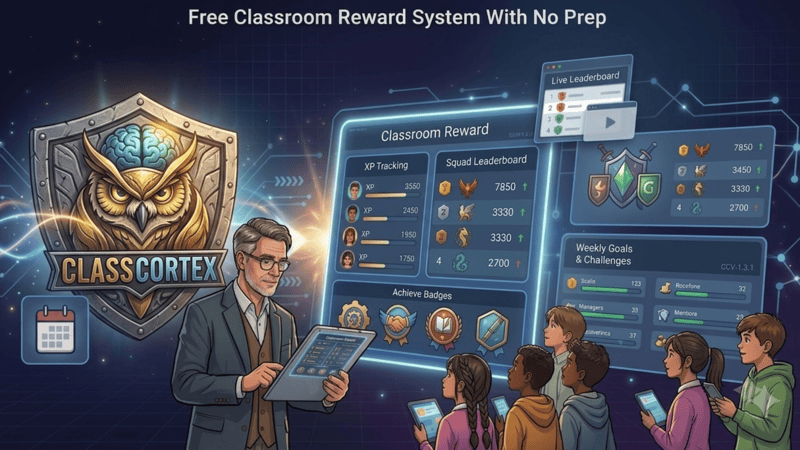
Class Cortex is built around exactly that model. Three reward layers run simultaneously - individual XP, squad competition, and milestone badges - each targeting a different student motivation profile. Together they cover the students who respond to personal progress, the students who are driven by peer competition, and the students who need long-term recognition. None of the three layers requires prep, printing, or physical materials. If you want a broader look at how this sits within a full gamification framework, our classroom reward system ideas guide covers the strategic layer this post builds on.
Why Most Free Classroom Reward Systems Fail
The most common failure mode for classroom reward systems is not a lack of teacher enthusiasm - it is administrative decay. Physical token economies require restocking. Paper tracking charts require printing and updating. Merit certificates require design time and a functioning printer. Each of these maintenance tasks is trivial in Week 1 when the system is new. By Week 5, they are friction points that get deprioritised against everything else on a teacher's plate. The system quietly stops running and nobody formally closes it down - it just fades.
The second failure mode is aesthetic. Secondary students are acutely sensitive to what feels age-appropriate. A sticker chart that would genuinely excite a Year 3 student will be received with flat silence - or worse, open contempt - by a Year 9 class. The reward system needs to feel like something students actually want to engage with, and that means it needs to look like the games and apps they already use voluntarily in their own time, not like a primary school classroom decoration.
The third failure mode is the reset problem. Many reward systems start fresh each week or each term, which removes the accumulation that drives long-term engagement. Students who are behind do not try to catch up - they wait for the reset. Students who are ahead coast. A system where XP accumulates all term, where the gap between ALPHA squad on Week 1 and ALPHA squad on Week 8 is visible and meaningful, creates fundamentally different behaviour than a system that wipes the slate clean every Friday.
The Three Reward Layers in Class Cortex
The free classroom reward system in Class Cortex operates as three simultaneous layers, each targeting a different motivation type. You do not choose between them - all three run at once from the moment you open the app.
Layer 1 - Individual XP and HP
Every student has their own XP total and HP bar on the Command Deck. XP accumulates for task completion, quality contributions, Neural Training game performance, and any other moment the teacher chooses to award points. HP is a consequence layer - it can decrease for disruptive behaviour, and students who run low on HP are visually flagged on the display. Both carry across every lesson, every week, all term. This layer rewards students who are motivated by personal progress and individual recognition - the students who want to see their own number go up, independent of how anyone else is doing.
Layer 2 - Squad Leaderboard Competition
Students are divided into four to six squads - ALPHA through FOXTROT - each with a live XP bar on the main display. Every XP point a student earns contributes to their squad's total. The leaderboard is always visible on the smartboard during lessons, which means the competitive dynamic runs in the background of every activity without the teacher actively managing it. Squadmates start regulating each other's behaviour because they can see the live consequence on the board. This layer targets students who are motivated by peer competition and group belonging rather than individual achievement - the students who would not work especially hard for their own score but will absolutely not be the person who costs their squad the lead.
Layer 3 - CC-Achieve Milestone Badges
CC-Achieve badges are milestone recognition awards that unlock automatically when a student's cumulative XP crosses specific thresholds. They appear on the student's profile in the Command Deck and are visible to the class. Unlike XP (which is continuous) and squad competition (which is relative), CC-Achieve badges are absolute milestones - they recognise total effort over time regardless of how other students are performing. This layer targets students who respond to long-term achievement tracking: the students who need to see their sustained contribution recognised in a way that is not erased by a classmate overtaking them on the leaderboard. The same Achievements tab also runs the Neural Core Economy, where students spend banked XP unlocking their own avatar - the first tier is free for every student on every class, and whatever gets bought is kept for good even through an XP reset. It costs nothing but XP, so it stays inside the "no prep, no budget" spirit of this whole layer.
Which students each layer reaches
- Individual XP: High achievers who want personal recognition, students who respond to seeing a number grow, those who disengage when reward feels group-dependent.
- Squad leaderboard: Socially motivated students, competitive students who work harder when peers are watching, students whose effort increases when they feel accountable to a team.
- CC-Achieve badges: Students who need long-term recognition, those who lose motivation mid-term when the leaderboard is dominated by the same squads, students who value achievement markers over daily competition.
- Boss Battle (weekly reward): The whole class - cooperative excitement that rewards the collective effort of the week rather than individual performance.
The Boss Battle as the Weekly Class Reward
Sitting above the three individual reward layers is the weekly class-wide reward: the Boss Battle. When the squad XP goal for the week is hit, the last fifteen minutes of Friday's lesson is a live multiplayer Boss Battle. Students join at classcortex.com/join via QR code on their own devices - no accounts, no login, no setup overhead. The teacher reveals questions on the main display, the class answers together, and the boss HP bar drops with each correct answer.
The Boss Battle works as a reward specifically because it is conditional. If the weekly XP goal is not hit, there is no Boss Battle that week. No drama, no lecture - just the absence of the reward. Students learn very quickly that Tuesday's behaviour has a direct consequence on Friday's outcome, which means every lesson in the week is connected to something they genuinely want. For a full guide on running the Boss Battle effectively - question design, boss selection, role assignment, and timing - see our classroom Boss Battle teacher guide.
The Noise Monitor as a Passive Reward Mechanism
One of the most effective zero-prep reward tools in Class Cortex is the Sonic Defence Noise Monitor, because it rewards quiet behaviour without any teacher action. The Quiet Streak tracker awards bonus XP to the class every 30 seconds the room stays below the calibrated noise threshold. Students can see the streak counting on the display - which creates a visible incentive for self-regulation that requires no teacher involvement whatsoever.
On the free tier, when the threshold is crossed, a visual alarm fires and the Quiet Streak resets. Students quickly learn that one person talking resets the bonus XP counter for everyone, which creates peer accountability far more efficiently than a teacher repeating instructions. Pro users get Noise Auto-Penalty mode, which goes further: XP deducts automatically from the class scoreboard when noise crosses the threshold - completely hands-free, no teacher action required at any point. The room learns to manage itself.
What This Reward System Does Not Require
It is worth being direct about what this free classroom reward system does not need, because the contrast with traditional approaches is significant. It does not require printing. It does not require purchasing tokens, stickers, or certificates. It does not require a separate tracking spreadsheet. It does not require student accounts, parent permissions, or IT approval. It does not require additional lesson planning time - the reward structure operates on top of whatever you are already teaching.
The only setup is adding your class roster and assigning squads, which takes roughly ten minutes the first time and never needs to be repeated for that class. Everything else - XP accumulation, squad scoring, badge unlocking, noise monitoring, Quiet Streak tracking - runs automatically from that point forward. The system gets more effective the longer it runs, not less, because the accumulated XP gap between squads and the badge milestones students are approaching become increasingly meaningful as the term progresses.
No student accounts. No credit card. No install.
Frequently Asked Questions
What is the best free classroom reward system with no prep?
Class Cortex is the best free classroom reward system with no prep. It uses a three-layer reward structure: individual XP and HP per student, squad leaderboard competition across six teams, and CC-Achieve milestone badges awarded automatically at XP thresholds. No printing, no sticker charts, no tokens to manage, and no cost. Open classcortex.com/app in Chrome, add your class roster, and the system is live before your first lesson.
How do I reward students without spending money?
The most durable zero-cost reward approach is a digital XP system with visible leaderboards. Class Cortex provides individual XP per student, six competing squad bars on a main display, and CC-Achieve milestone badges at XP thresholds - all free. The Boss Battle is earned as a class-wide reward when the weekly XP goal is hit. None of this costs anything and none of it requires printing, tokens, or physical materials.
What is a CC-Achieve badge in Class Cortex?
CC-Achieve badges are milestone recognition awards in Class Cortex that unlock automatically when a student's XP reaches specific thresholds. They appear in the student's profile on the Command Deck and are visible on the class display. Badges recognise cumulative effort rather than single-lesson performance, which makes them a reliable motivator for students who respond to long-term achievement tracking rather than immediate praise.
Why do sticker charts and token economies fail for secondary students?
Sticker charts and token economies fail with secondary students for two main reasons. First, the aesthetic is too young - physical sticker charts read as primary school tools and secondary students find them patronising. Second, they require constant teacher administration: buying tokens, printing charts, tracking manually, restocking materials. The administrative overhead grows over the term while student engagement decays. A digital XP system avoids both problems - it runs automatically and looks like something students actually respect.
How does the Boss Battle work as a classroom reward?
The Boss Battle is a class-wide reward unlocked when the squad XP goal is hit for the week. Students join at classcortex.com/join via QR code on their own devices - no accounts required. The teacher reveals questions on the main display, students answer on their devices, correct answers deal damage to the boss and wrong answers cost the class HP. Running it as a Friday reward tied to the weekly XP goal means every lesson in the week feeds into Friday's outcome - sustaining engagement across the full week rather than just during the Battle itself.
Further Reading