The most exhausting part of secondary behaviour management is not the behaviour itself - it is the negotiation that follows. A student talks during direct instruction. You issue a warning. They contest it. You repeat the warning. They argue the point. By the time the exchange is over, three minutes of lesson time are gone, the rest of the class has disengaged, and the student is now performing defiance rather than correcting the behaviour. The consequence became a confrontation.
A classroom HP system sidesteps that dynamic almost entirely. When a student loses HP on the visible scoreboard, the consequence is immediate, visible, and located inside a system the student opted into at the start of term. It is not the teacher's judgment being contested - it is a bar going down, the same way a bar goes down when you take a hit in any game they play voluntarily outside school. The language is native. The logic is accepted. The argument does not happen.
This is not a trick or a distraction technique. It is a reframing of consequence from a social confrontation between a student and an authority figure into a logical outcome within a system. The distinction matters enormously for secondary students, who are developmentally wired to push back against perceived authority and who respond very differently to the same consequence depending on whether it feels personal or systemic. For broader context on how HP sits within a full gamification model, read our guide on how to gamify your classroom without losing control - HP is the consequence layer that makes the XP system complete.
What HP Actually Is in a Classroom Context
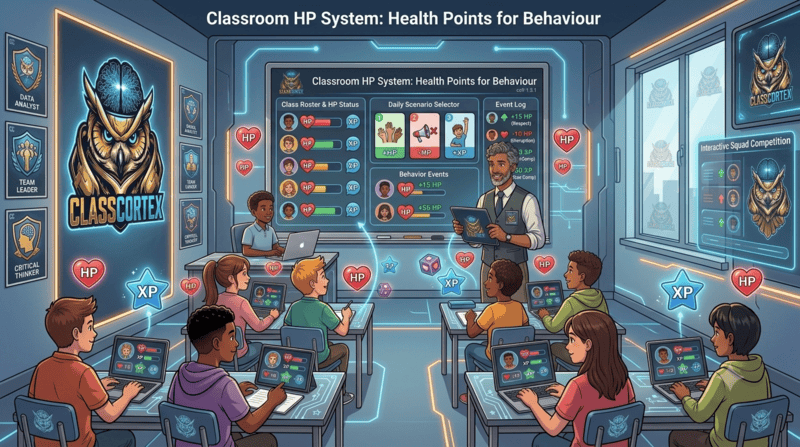
Health points in a classroom HP system work exactly as they do in games: each student starts with a full HP bar, and disruptive behaviour causes it to decrease. The HP bar is visible on the main display - in Class Cortex, it appears on the Command Deck alongside each student's XP total, so the whole class can see both the reward track and the consequence track simultaneously.
The critical design element is that HP is not a permanent punishment - it is a live resource that can be recovered. Students who lose HP can earn it back through sustained positive behaviour, excellent contributions, or strong performance in Neural Training games and Boss Battles. This recovery mechanic is what separates an HP system from a simple demerit tally: it creates active incentive to course-correct rather than giving up once points are lost.
Why HP Works Where Warnings Fail
Verbal warnings fail with secondary students for a consistent structural reason: they are socially expensive. Issuing a warning in front of the class positions the teacher and student in a public power dynamic. The student's social stakes in that moment are often higher than any consequence the warning threatens - looking compliant in front of peers is a social cost, and many secondary students will absorb a detention before they will accept a warning without pushback in front of the class.
HP removes that dynamic. The teacher clicks a button. The bar goes down on the display. No verbal exchange required. No singling out. No public negotiation. The student sees their bar decrease, the class sees the display change, and the lesson continues. The consequence has been delivered and recorded without a confrontation occurring. For students who are specifically triggered by the feeling of being called out, this is a genuinely different experience than a traditional warning.
Demerits fail for a related reason: they are disconnected from any gain mechanic. A demerit is pure negative consequence with no pathway back. Students who accumulate demerits early in a term often disengage from the behaviour system entirely because they calculate that recovery is impossible. HP, by contrast, exists in the same system as XP - both run simultaneously on the same display, and positive behaviour moves both bars in the right direction. The student who lost HP during Tuesday's lesson has a visible reason to behave well on Wednesday.
How to Set Up HP in Your Classroom
In Class Cortex, HP is configured on the Command Deck alongside XP. Each student starts with a full HP bar at the beginning of the term - 100 HP by default, though you can adjust the scale to match your preference. HP is deducted by clicking the student's profile and entering the HP change. This takes approximately two seconds and can be done without breaking the flow of the lesson - a single click on the teacher's device, visible immediately on the main display.
HP rate card - a starting framework
- -5 HP: Off-task behaviour after one redirect (talking, phone, not starting work). The lightest consequence - enough to register on the display without feeling punitive for minor infractions.
- -10 HP: Repeated disruption in the same lesson after an HP deduction has already been applied. Escalation without requiring a separate formal warning process.
- -20 HP: Significant disruption affecting other students or refusing to redirect. At this threshold, the bar becomes visually striking on the display - yellow shifting toward red - without any teacher commentary needed.
- +10 HP recovery: Sustained on-task behaviour for the remainder of a lesson following an HP deduction. Makes the recovery mechanic explicit and visible.
- +15 HP recovery: Excellent contribution to class discussion or outstanding task quality. Gives high-achieving students a reason to engage with the HP system positively even if they rarely lose points.
- +20 HP recovery (Boss Battle): Correct answers during a Boss Battle can restore class HP. Connects the individual HP system to the collective reward event.
HP and the Noise Monitor Working Together
One of the most effective combinations in Class Cortex is the HP system running alongside the Sonic Defence Noise Monitor. The noise monitor handles ambient noise levels automatically - on the free tier, crossing the calibrated threshold fires a visual alarm and audio cue, with the Quiet Streak tracker rewarding 30 seconds of quiet with bonus XP. Pro users get Noise Auto-Penalty mode, which deducts XP from the class scoreboard automatically when noise breaches the threshold, with no teacher action required.
The HP system handles the individual behaviour layer that the noise monitor cannot reach - specific students who are off-task, refusing to redirect, or disrupting in ways that are targeted rather than ambient. Together they cover the full spectrum: the room's overall noise level is managed automatically, and individual behaviour has a visible, systemic consequence that does not require a verbal confrontation. The result is a classroom where the teacher can spend the vast majority of lesson time teaching rather than managing.
For teachers managing particularly challenging classes, running both systems simultaneously creates a reinforcing structure: the noise monitor keeps whole-class volume in check, and the HP system handles individual escalation. Neither requires the teacher to stop, address the class, or enter a behavioural negotiation. Both consequences are delivered through the display.
HP in the Boss Battle
The classroom HP system connects directly to the Boss Battle in two ways. First, individual HP is a visible reflection of how each student has behaved during the week - students who arrive at Friday's Boss Battle with low HP have a clear social signal to the class about the week's behaviour record. Second, class HP is a live resource during the Boss Battle itself: wrong answers cost the class HP, and the class loses if HP reaches zero before the boss is defeated.
This connection creates a natural alignment between individual behaviour during the week and collective success during the Boss Battle. Students who have maintained their HP throughout the week are contributing to a class that arrives at the Battle in good standing. It is not a direct mechanical link - individual HP and Boss Battle HP are separate - but the narrative connection is clear to students, and it creates a social incentive for sustained behaviour that a standalone HP system cannot generate on its own. Our classroom Boss Battle guide covers how to structure the Battle session itself, including how to use HP mechanics during the fight to maximum effect.
What HP Is Not
It is worth being clear about what a classroom HP system should not do. HP should not replace your school's formal behaviour management process. If a student reaches a threshold that warrants a formal consequence - a referral, a parent contact, a detention - the HP system does not substitute for that. It is a classroom-level behaviour layer, not a school-wide discipline framework.
HP should also not be used punitively or disproportionately. Deducting 50 HP for a minor infraction destroys the recovery mechanic and sends the student into a deficit they perceive as unrecoverable - which produces the same disengagement as a heavy demerit system. Calibrate HP deductions so that even a student who has a bad lesson can see a realistic path back to full HP by the end of the week. The system works because recovery is always possible. The moment it stops feeling recoverable, it stops producing the behaviour change you want.
No student accounts. No credit card. No install.
Frequently Asked Questions
What is a classroom HP system?
A classroom HP system uses health points - borrowed from video game language - as a consequence layer for behaviour. Each student has a visible HP bar that decreases for disruptive behaviour and can be restored through positive actions. Unlike verbal warnings or merit deductions, HP works within a game logic students already understand and accept. In Class Cortex, HP runs alongside XP so students have both a gain mechanic (earning points) and a consequence mechanic (losing health) operating simultaneously.
How does HP work differently from warnings or demerits?
Warnings and demerits position the teacher as the authority issuing the consequence, which often triggers argument or resentment. HP positions the consequence inside a system students have opted into - the same logic as losing a life in a game. Students do not argue with a game mechanic the way they argue with a teacher's judgment. HP is also visible and persistent, which means students can see exactly where they stand and take deliberate action to recover - something a verbal warning or demerit does not allow.
How do you restore HP once it is lost?
HP is restored through positive behaviour and achievement. In Class Cortex, the teacher can award HP directly for sustained effort, excellent contributions, or a positive shift in behaviour mid-lesson. The Boss Battle is also a natural HP event - correct answers can restore class HP as well as dealing damage to the boss. Setting up a clear HP recovery mechanic from the start is important: students need to know HP loss is not permanent and that deliberate positive action has a visible payoff.
Can HP work for secondary students or is it too childish?
HP works exceptionally well for secondary students precisely because it borrows from the game language they use voluntarily outside school. The concept of a health bar is native to students who play any video game - it is not a primary school construct. The key is the aesthetic context: HP displayed on a dark tactical scoreboard in a mission-control interface reads very differently from a sticker chart. Class Cortex is designed specifically for secondary aesthetics, which is why the HP system lands with Year 7 through Year 10 cohorts.
How does the HP system connect to the Boss Battle?
In Class Cortex Boss Battles, class HP is a live resource during the session. Wrong answers cost the class HP, correct answers deal damage to the boss, and the class loses if HP reaches zero before the boss is defeated. Students who have maintained their individual HP throughout the week arrive at the Battle invested in protecting the class resource. The individual and collective HP systems reinforce each other naturally without requiring a direct mechanical link.
Further Reading