Blooket is genuinely popular. Students enjoy the collectible characters, the randomised game modes, and the competitive quiz structure. For primary and lower secondary classes, it lands well - low stakes, high fun, easy to run. But once you start teaching Year 8 and above, the cracks appear. The Blook aesthetic reads as too young. The self-contained session structure means nothing carries over. And you are still managing twenty-five students with no system to back you up between quiz days.
The search for a blooket alternative free from these limitations usually starts in the same place: teachers want something that has the engagement of Blooket but with a persistence layer - XP that accumulates across weeks, competition that runs all term, and tools that work during regular lessons, not just game days. That gap is exactly what this comparison covers.
If you want context on how persistent gamification differs from session-based quiz tools, our guide on how to gamify your classroom without losing control explains the structural differences and why one model sustains engagement significantly longer than the other.
Why Secondary Students Outgrow Blooket
Blooket was designed for engagement through novelty - new game modes, random Blook drops, and the excitement of not knowing which format is coming next. That novelty is effective for a while. But secondary students are pattern recognisers. Once they have played Gold Quest, Café, and Tower Defense enough times, the novelty wears off and what remains is a standard quiz with a cosmetic layer.
The deeper problem is structural. Blooket has no memory. Every session starts fresh. There is no squad that has been building XP since Week 1, no leaderboard that remembers what happened on Tuesday, no consequence system that runs while you are teaching rather than during a dedicated game slot. For primary students, self-contained sessions are fine. For secondary students who respond to long-term stakes and peer accountability, the reset-to-zero model is a ceiling.
Games like Blooket for high school can also run into aesthetic problems. Secondary students are acutely aware of what looks childish. Bringing up Blooket on the smartboard in Year 10 is a different social dynamic than Year 4. Tools that take themselves seriously - mission control interfaces, squad-based competition, consequence automation - land very differently with older cohorts.
1. Class Cortex - Best Blooket Alternative for Persistent Engagement
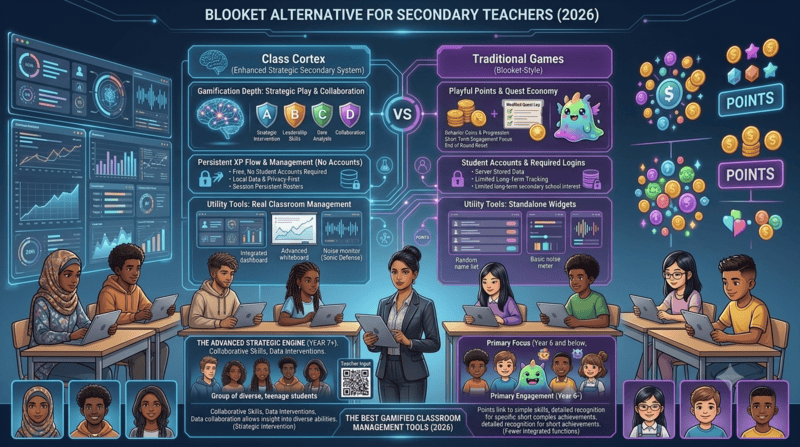
Class Cortex is the most direct answer to what secondary teachers are actually looking for when they search for a blooket alternative. It is not a quiz platform - it is a full classroom management system with gamification built in, designed specifically for Year 5 upwards by a teacher who spent years trying to make Blooket-style tools work with older students and kept hitting the same wall.
What Class Cortex does that Blooket cannot:
- Persistent XP and HP per student: Every student's score carries across every lesson, every week, all term. There is no reset unless you choose one. The leaderboard on Monday reflects everything that happened the previous week - which means Tuesday's effort actually means something.
- Six competing squads: Students are assigned to ALPHA through FOXTROT squads, each with their own XP bar on the main display. Squad accountability is peer-driven - squadmates regulate each other's behaviour because the leaderboard is public and permanent.
- Live multiplayer Boss Battle: Students join at classcortex.com/join via QR code, no accounts required. The teacher reveals questions, students answer on their own devices, correct answers deal damage to the boss, wrong answers cost the class HP. This is the format that fills the Blooket-shaped gap without the Blook aesthetic.
- Sonic Defence Noise Monitor: The microphone-based noise monitor runs in the background during regular lessons. On the free tier, crossing the calibrated threshold fires a visual alarm and audio cue, plus the Quiet Streak tracker awards bonus XP every 30 seconds the room stays quiet. Pro users get Noise Auto-Penalty mode, which automatically deducts XP from the class scoreboard when noise breaches the threshold - completely hands-free, no teacher intervention needed.
- Neural Training Simulator: Eight built-in classroom mini-games (four free, four Pro) that award XP automatically on completion. DATA_BREACH (typing speed), SECTOR_MATH (mental arithmetic), MAINFRAME_HACK (logic puzzles), and CIPHER_PROTOCOL (code-breaking) are all free. These replace the need for a separate quiz tool during most lessons.
- Everything in one tab: Countdown timers, seating map, random student picker, tactical whiteboard, scoreboard, training games - all running simultaneously without switching browser tabs.
Price: Permanently free core tier. Pro is AUD $49 / year.
Best for: Years 5-10. Teachers who want engagement that runs all term, not just during game sessions.
2. Kahoot - Recognisable but Account-Dependent
Kahoot is the tool most teachers reach for before Blooket, and it still holds significant classroom presence. Live question-and-answer format, music, leaderboard after each question - it is a proven engagement format. For a detailed comparison of Kahoot alongside other quiz tools, see our Kahoot alternative guide which covers the full field.
The limitations at secondary level are consistent with Blooket's: each session is self-contained, student accounts are required for full functionality, and there is no persistent layer that carries XP forward. Kahoot also now sits behind more aggressive paywalls for classroom features that were previously free. The engagement spike on day one of a new class rarely survives past Week 3.
Price: Free tier available. Pro from approximately USD $17/month. Best for: One-off review sessions where novelty is the goal and persistence is not required.
3. Gimkit - Stronger Mechanics, Same Account Problem
Gimkit sits a step above Blooket in mechanical depth. The farming loop in Kit modes (answer questions, earn currency, spend currency on upgrades during the session) creates genuine in-session strategy. For secondary students who have burned through Blooket's novelty, Gimkit's mechanics feel meaningfully different.
It requires student accounts for almost anything beyond the most basic mode. The in-session economy resets when the session ends. And like all quiz platforms, it sits outside your classroom management system - meaning Gimkit XP does not talk to anything else, and the behaviour management problem persists in every non-Gimkit lesson.
Price: Free tier very limited. Individual plans from approximately USD $11.99/month. Best for: Teachers who specifically want quiz-game mechanics and whose students are willing to maintain accounts.
4. Quizizz (now Wayground) - Self-Paced Option
Quizizz recently rebranded to Wayground, creating significant search confusion - many teachers searching for Quizizz alternatives are actually looking for the platform by a different name. The self-paced quiz format is its strongest differentiator: students work through questions at their own speed rather than being locked to the class timer. Meme feedback after each question adds levity.
Student accounts are required. There is no persistent classroom management layer. The rebrand has also disrupted the user experience for existing users who are still adjusting to the new interface and feature restructure. For secondary teachers who specifically want self-paced quiz delivery, Wayground remains functional - but it does not solve the between-lesson engagement problem.
Price: Free tier available. Pro from approximately USD $15/month. Best for: Asynchronous and self-paced quiz delivery where every student works at their own speed.
Side-by-Side Comparison
| Feature | Class Cortex | Blooket | Kahoot | Gimkit |
|---|---|---|---|---|
| Persistent XP Across Lessons | ✓ All term | ✗ Resets | ✗ Resets | ✗ Resets |
| No Student Accounts | ✓ | Partial | Partial | ✗ Required |
| Squad / Team Competition | ✓ 6 squads | In-session only | In-session only | In-session only |
| Noise Monitor | ✓ + XP penalty (Pro) | ✗ | ✗ | ✗ |
| Seating Map + Whiteboard | ✓ | ✗ | ✗ | ✗ |
| Secondary-Appropriate Aesthetic | ✓ Tactical/sci-fi | Skews primary | ✓ Neutral | ✓ Neutral |
| Annual Cost (AUD approx.) | Free / $49 | Free / ~$90+ | Free / ~$300+ | Free / ~$220+ |
The Verdict
If what you need is a one-off quiz activity for a review lesson, Blooket, Kahoot, and Gimkit all work. Pick whichever your class responds to. But if you are searching for a blooket alternative because you want something that actually manages your secondary class across an entire term - something that builds, accumulates, and runs even when you are not running a game - then the comparison is not close.
Class Cortex is the only tool in this list that functions as a classroom management system rather than a quiz game. The XP carries forward. The squad competition is always live. The noise monitor runs in the background during regular instruction. The Boss Battle gives you the session-based engagement format without requiring a separate platform or student accounts. You can read more about how the Boss Battle fits into a weekly gamification structure in our classroom Boss Battle guide.
Open classcortex.com/app in Chrome, add your class roster, and it is running before the bell. No student accounts. No IT request. No install.
No student accounts. No credit card. No install.
Frequently Asked Questions
What is the best Blooket alternative for secondary teachers?
Class Cortex is the best Blooket alternative for secondary teachers who want engagement that lasts beyond a single session. Where Blooket resets after each game, Class Cortex carries XP and HP across every lesson, runs six competing squads on a persistent leaderboard, and includes a live multiplayer Boss Battle mode. No student accounts required. Free to use.
Why doesn't Blooket work well for high school students?
Blooket works best with younger students who engage with its collectible Blook characters and casual game modes. High school and secondary students often find the aesthetic too young and the mechanics too shallow - each session is self-contained with no progression that carries forward. Secondary students respond better to systems with persistent XP, squad accountability, and deeper consequence mechanics.
What are the best free Blooket alternatives?
The best free Blooket alternatives for teachers are Class Cortex (persistent XP, squad teams, Boss Battles, noise monitor - no student accounts), Kahoot (live quiz, student accounts required), Gimkit (farming game mode, student accounts required), and Quizizz/Wayground (self-paced quiz with student accounts). Class Cortex is the only option that functions as a full classroom management system rather than a standalone quiz game.
Does Class Cortex require student accounts like Blooket?
No. Class Cortex requires zero student accounts, app downloads, or logins. Students join Boss Battles by scanning a QR code at classcortex.com/join - no email, no password, no registration. All class data is stored in the teacher's browser. COPPA and GDPR compliant by design. No IT approval required.
Can you use Blooket alternatives without student accounts?
Class Cortex is the only tool in this comparison that requires no student accounts for any feature. Kahoot, Gimkit, and Blooket all require students to sign in or create accounts for full functionality. Class Cortex runs entirely from the teacher's browser, with students joining multiplayer Boss Battles via QR code only - no account creation at any point.
Further Reading